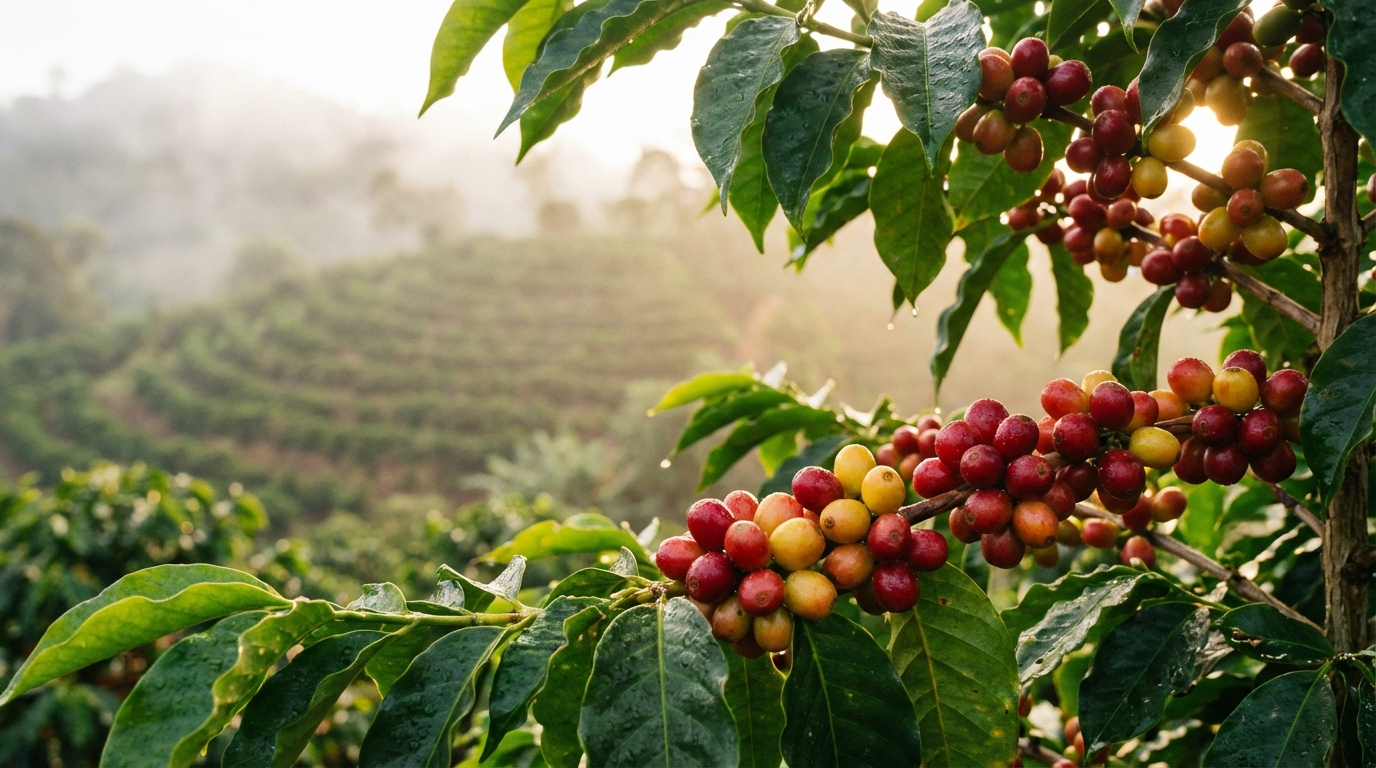
In the world of specialty coffee, few varieties carry as much history and prestige as Bourbon. Considered one of the oldest and most genetically pure cultivars of the Arabica species, Bourbon is revered by producers, roasters, and baristas for its natural sweetness, velvety body, and aromatic complexity. If you have ever tasted a specialty coffee that seemed to caress your palate with notes of caramel and ripe fruit, there is a good chance it was a Bourbon.
The History: From Ethiopia to Bourbon Island
The Origins
The entire story of Arabica coffee begins in Ethiopia, where the species Coffea arabica grows wild in highland forests. In the 15th century, seeds were taken to Yemen, where coffee began to be cultivated systematically. It was from these Yemeni plantations that the two great lineages of Arabica emerged: Typica and Bourbon.
The Island That Named the Coffee
In the early 18th century, French missionaries brought coffee seeds from Yemen to the Isle of Bourbon, now known as Reunion Island, a French territory in the Indian Ocean near Madagascar. In this isolated environment, with fertile volcanic soil and a tropical highland climate, the plants adapted and developed unique characteristics over decades of natural selection.
The name “Bourbon” comes directly from this island, which was called Ile Bourbon at the time in honor of the French royal dynasty. When these seeds began to be distributed to other coffee-growing regions in the 19th century, they carried with them the name of the island that had shaped them.
The Global Spread
From Bourbon Island, the cultivar traveled to the African continent, to Central America, and, crucially, to Brazil. Each new region brought adaptations and natural mutations, giving rise to sub-varieties that maintain the Bourbon DNA but express characteristics unique to their local terroir.
Yellow Bourbon vs. Red Bourbon
One of the most well-known distinctions in the Bourbon world is the difference between the Yellow and Red varieties, referring to the color of the fruit when ripe.
Red Bourbon
Red Bourbon is the original variety, genetically closest to the plants that arrived on Bourbon Island. Its fruits ripen to an intense red, and the resulting coffee tends to display:
- More pronounced, bright acidity
- Citrus and red fruit notes
- Medium to full body
- Clean finish with a subtle sweet aftertaste
Red Bourbon is frequently considered more complex in acidity, making it a favorite in coffee competitions and among enthusiasts who value brightness in the cup.
Yellow Bourbon
Yellow Bourbon is a natural mutation that appeared in Brazil, likely the result of a spontaneous cross between Red Bourbon and Yellow Typica. Its fruits ripen to a golden yellow, and the sensory profile tends to offer:
- More intense, enveloping sweetness
- Notes of caramel, honey, and yellow fruits (peach, apricot)
- Creamy, velvety body
- Softer, rounder acidity
- Prolonged, chocolatey finish
Yellow Bourbon is especially appreciated by those who seek coffees with prominent sweetness and mild acidity, making it an excellent gateway for anyone beginning to explore specialty coffee.
In Practice
The difference between Yellow and Red is not absolute. Terroir, altitude, processing, and roast significantly influence the final result. A high-altitude Red Bourbon can be sweeter than a low-altitude Yellow Bourbon. The key is to understand these varieties as sensory tendencies, not rigid categories.
Sensory Characteristics of Bourbon
Regardless of color, Bourbon as a variety has a recognizable sensory profile that distinguishes it from other cultivars:
Sweetness
Sweetness is Bourbon’s signature. Compared to other Arabica varieties, Bourbon tends to accumulate more sugars in its beans, a result of its slower maturation. This translates into notes of:
- Caramel and brown sugar
- Wild honey
- Milk chocolate
- Subtle vanilla
Body
Bourbon’s body is frequently described as silky or velvety. It is not the heavy density of a Robusta, but an enveloping texture that coats the palate pleasantly. This characteristic makes Bourbon a versatile choice, performing well in both filtered methods and espresso.
Acidity
Bourbon’s acidity is balanced and pleasant, never aggressive. Depending on the region and processing, it can manifest as:
- Light citric acidity (lemon, tangerine)
- Stone fruit acidity (peach, plum)
- Subtle winey acidity, reminiscent of white wines
Aromatic Complexity
Bourbon offers a rich aromatic profile that develops as the coffee cools. It is common to notice transformations in the cup: what begins with chocolate notes may reveal fruits and flowers as the temperature drops. This evolution is one of the reasons Bourbon is so highly valued in tastings and cuppings.
Bourbon in Brazil
Brazil has a special relationship with Bourbon. The cultivar arrived in the country in the 19th century and found ideal conditions in several coffee-growing regions, becoming one of the pillars of Brazilian specialty coffee production.
Sul de Minas (Southern Minas Gerais)
The Sul de Minas region is one of the most traditional Bourbon-producing areas in Brazil. With altitudes between 900 and 1,300 meters, mild temperatures, and rich soils, the Bourbons from this region tend to present a full body, intense chocolate and caramel sweetness, and balanced acidity.
Mogiana (Sao Paulo State)
The Mogiana region in the interior of Sao Paulo state has a long coffee-growing tradition and produces Bourbons with a distinct sensory profile: more present citric acidity, medium body, and yellow fruit notes. Slightly lower altitudes and a warmer climate contribute to this differentiation.
Cerrado Mineiro
The Cerrado Mineiro, with its well-defined climate alternating between dry and wet seasons, produces Bourbons with uniform maturation and a consistent sensory profile. Coffees from here typically feature notes of nuts, dark chocolate, and more restrained acidity.
Chapada Diamantina
In the state of Bahia, the Chapada Diamantina has been gaining recognition as a specialty coffee-producing region, including high-altitude Bourbons with floral and fruity profiles that surprise even the most experienced palates.
Why Bourbon Is Challenging for Producers
Despite all the quality in the cup, Bourbon presents significant challenges for producers:
- Lower productivity: compared to modern varieties like Catuai and Mundo Novo, Bourbon produces fewer fruits per plant
- Disease susceptibility: especially to coffee leaf rust (Hemileia vastatrix), which can devastate entire plantations
- Tall stature: Bourbon plants grow taller, making harvesting more difficult and requiring more space between rows
- Uneven maturation: the fruits do not always ripen at the same time, requiring selective harvesting
These challenges explain why Bourbon lost ground to more productive and resistant varieties in commercial production. But this is precisely why quality Bourbon commands value: it demands dedication and care from the producer, and rewards with an exceptional cup.
How to Appreciate a Bourbon
To get the most out of a Bourbon coffee, here are some suggestions:
- Pour-over methods (V60, Chemex, Kalita): highlight the delicate acidity and natural sweetness
- French press: emphasizes the velvety body and chocolate notes
- Espresso: produces shots with dense crema and intense sweetness, excellent on its own or as a base for milk drinks
- Temperature: try Bourbon at different temperatures as it cools; new notes emerge as the temperature drops
Visit Consciencia Cafe and discover our selected Bourbons. Our baristas can guide you through a comparative tasting of Yellow and Red Bourbon, showing how this timeless classic continues to surprise, cup after cup. Located in Foz do Iguacu, just a short drive from Iguazu Falls, we are the perfect stop for coffee lovers exploring the Triple Border region.