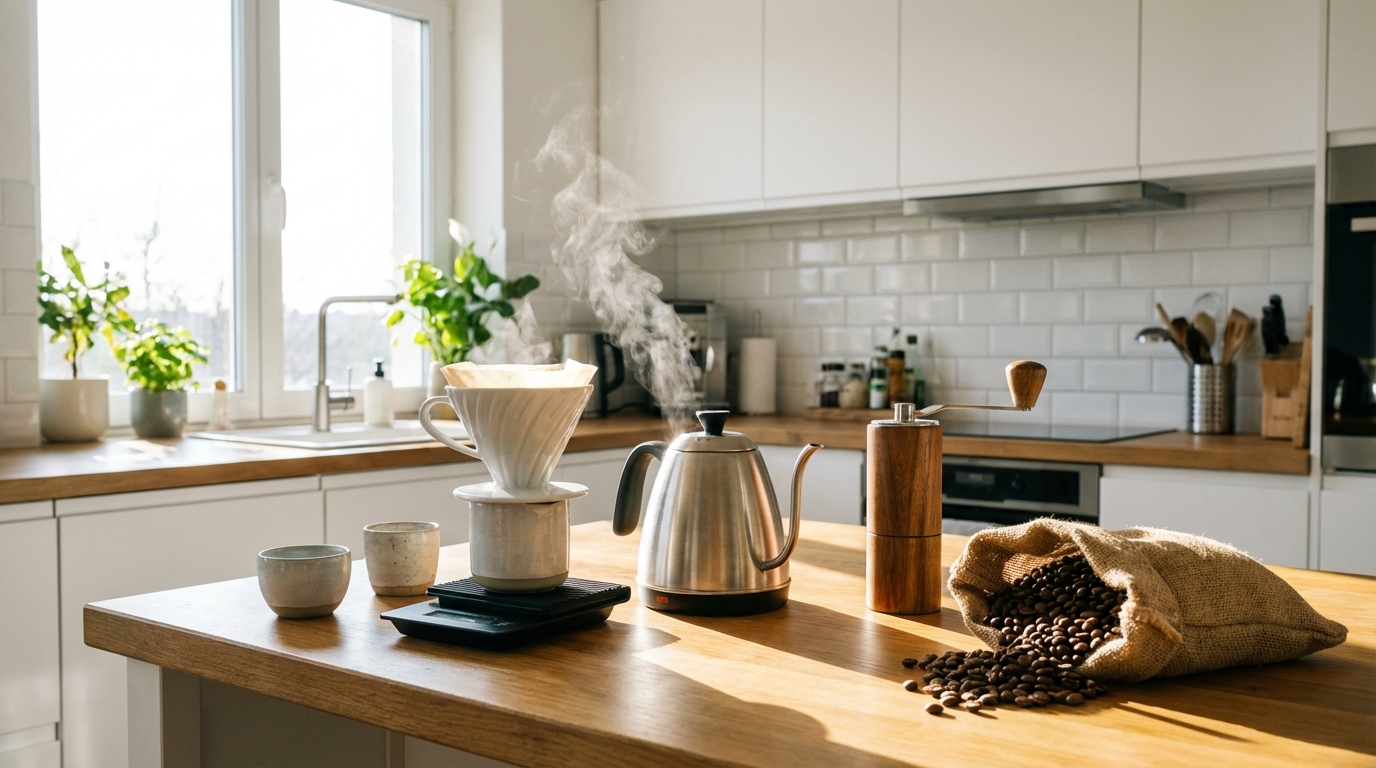
If you love specialty coffee, chances are you have thought about setting up a dedicated brewing space at home. The good news is that you do not need to spend a fortune to get started. With a few essential tools and some basic knowledge, you can turn a corner of your kitchen into a proper coffee station that rivals what many cafes produce.
In this guide, we walk through three investment tiers, from budget-friendly to enthusiast-level, so you can find the path that best fits your wallet and your curiosity about the world of coffee.
Basic station: around $50
For beginners, the essentials come down to controlling the fundamental variables of brewing: water quality, the coffee-to-water ratio, and grind size. With approximately $50, you can assemble a station capable of producing coffee far better than what most people drink every day.
Pour-over dripper (V60 or similar)
Paper filter brewing is one of the most accessible and versatile methods. The Hario V60, for example, costs between $8 and $15 depending on the material (ceramic, plastic, or glass). The paper filter removes excess oils and fine particles, resulting in a clean cup with well-defined tasting notes.
If you prefer something even simpler, a classic Melitta-style dripper works beautifully too. The important thing is to use quality filters and maintain a consistent pouring technique.
Gooseneck kettle
A gooseneck kettle allows you to control the flow of water during the pour. This makes an enormous difference in extraction because you can wet the coffee grounds evenly. Basic stovetop models cost between $10 and $20. You do not need an electric one at this stage.
Manual grinder
Grinding your coffee fresh is perhaps the single most impactful upgrade you can make. Pre-ground coffee loses aroma and freshness rapidly after grinding because the surface area exposed to air increases dramatically. A manual burr grinder costs between $15 and $25 and offers reasonably uniform grinding.
Kitchen scale
A simple digital kitchen scale with 1-gram precision costs around $10. It allows you to measure both coffee and water consistently. The classic ratio for filter methods is 1:15 to 1:17, meaning for every gram of coffee, you use 15 to 17 grams of water.
Intermediate station: around $150-200
With a larger investment, you gain versatility in brewing methods and greater precision in grinding. At this level, the coffee you make at home starts to rival what good cafes serve.
French press
The French press is a full-immersion method: the coffee steeps in water for a set period (usually 4 minutes) before being separated by a metal plunger. The result is a beverage with more body and texture, since the natural oils in the coffee pass through the metal filter. A quality model costs between $20 and $40.
Electric burr grinder
The difference between a basic manual grinder and an electric conical burr grinder is significant. The grind becomes more uniform, which improves extraction and reduces undesirable flavors like excessive bitterness or harsh acidity. Entry-level models cost between $50 and $100. Look for brands that allow grind size adjustment, as this gives you flexibility across different brewing methods.
Electric kettle with temperature control
Water temperature directly influences extraction. For most methods, the ideal range is between 90 and 96 degrees Celsius (195-205 Fahrenheit). An electric kettle with a built-in thermometer or temperature control costs between $30 and $60 and eliminates the guesswork.
Scale with built-in timer
A scale that doubles as a timer makes it easy to control brew time. You can monitor water flow rate and total brewing time without needing a separate device. Models cost between $20 and $40.
Advanced station: $500 and up
Those who have mastered manual methods and want to explore espresso at home enter more complex and more expensive territory. Espresso requires approximately 9 bars of pressure, very fine and consistent grinding, and precise temperature control.
Espresso machine
Home espresso machines vary enormously in price and quality. Entry-level models with pressurized portafilters start around $150, but for genuinely good results, consider investing $400 or more in a machine with stable heating and a non-pressurized portafilter. Brands like Breville, Gaggia, and Rancilio offer solid options in this range.
Dedicated espresso grinder
Espresso demands extremely fine and uniform grinding. General-purpose electric grinders cannot always achieve the necessary fineness. A dedicated espresso grinder with 50mm or larger conical or flat burrs starts around $200. It is a significant investment, but it is just as important as the machine itself.
Complementary accessories
At this tier, accessories like a calibrated tamper ($20-$50), a coffee distributor ($25-$60), and a steaming pitcher ($15-$30) complete the station. A knock box for disposing of spent pucks is also practical for daily use.
Universal tips for any budget
Regardless of how much you invest in equipment, certain principles are fundamental to getting the best out of your coffee.
Filtered water
Water makes up about 98% of your cup of filter coffee. If your tap water tastes of chlorine or has excessive mineral content, that will show up in the cup. Use filtered water, but avoid distilled or pure reverse-osmosis water, as the total absence of minerals impairs extraction. Ideally, your water should have a TDS (total dissolved solids) between 75 and 150 ppm.
Proper storage
The enemies of fresh coffee are oxygen, moisture, light, and heat. Store your beans in an airtight, opaque container at room temperature. Avoid the refrigerator, as moisture and odors from other foods can contaminate the coffee. Buy quantities you will consume within two weeks of the roast date.
Ratios and recipes
Start with a 1:16 ratio (one part coffee to sixteen parts water) and adjust to taste. If the brew is weak, increase the coffee dose or grind finer. If it is bitter, grind coarser or reduce contact time. Write down your recipes so you can replicate the results you like most.
Bean freshness
Specialty coffee hits its flavor peak between 7 and 21 days after roasting. Very fresh beans (less than 3 days) are still releasing carbon dioxide and can produce uneven extraction. Beans older than 30 days begin losing aromatic complexity.
Starting on the right foot
The most important thing is not having the most expensive equipment but understanding the process and paying attention to the variables. A well-prepared specialty coffee in a simple $8 dripper will always be better than a commercial-grade bean in a $1,000 machine.
Experiment, take notes, adjust. The specialty coffee journey is one of constant discovery, and every cup is an opportunity to learn something new.
Visit Consciencia Cafe in Foz do Iguacu, just minutes from Iguazu Falls, and try different brewing methods. Our team can help you choose the ideal equipment to build your home coffee station.