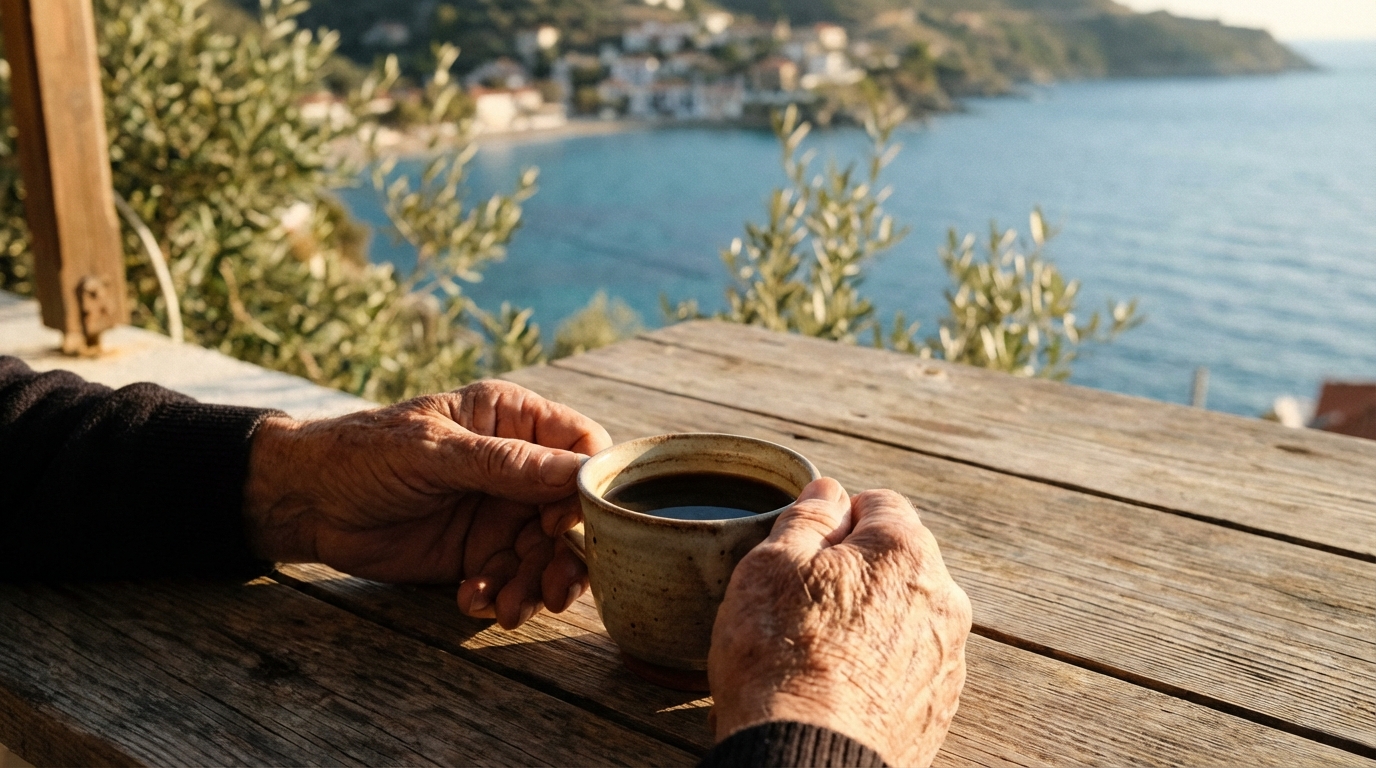
There are five places on Earth where people live significantly longer than the global average, with extraordinary concentrations of healthy, active centenarians. These places are called Blue Zones, and they were identified by researcher and explorer Dan Buettner in partnership with National Geographic. What makes these regions fascinating is not advanced medical treatments or privileged genetics, but rather simple and sustainable lifestyle habits. And among those habits, daily coffee consumption appears prominently in four of the five Blue Zones.
The Five Blue Zones of the World
Before exploring the connection to coffee, it is worth getting to know each of these regions and what makes them unique.
Okinawa, Japan
The Okinawa archipelago in southern Japan is famous for housing one of the highest concentrations of centenarians on the planet. Okinawans practice the concept of “hara hachi bu,” which means eating until you are 80 percent full. Their diet is rich in vegetables, tofu, purple sweet potato, and tea, with moderate coffee consumption.
Sardinia, Italy
The mountainous region of the Nuoro province on the island of Sardinia has a remarkable rate of male centenarians, something rare elsewhere in the world. Sardinians consume a classic Mediterranean diet with sheep cheese, whole-grain bread, red wine, and daily espresso.
Nicoya, Costa Rica
The Nicoya Peninsula in Costa Rica is one of the most long-lived regions in the Americas. Nicoyans eat a diet of beans, corn, squash, and tropical fruits, and have a daily habit of drinking strong coffee, usually in the morning and early afternoon.
Ikaria, Greece
The island of Ikaria in the Aegean Sea has a population where nearly one in three people reaches age 90. Ikarians follow a Mediterranean diet rich in olive oil, legumes, honey, and wild herbs. Greek coffee, prepared slowly and unfiltered, is a constant presence in daily routines.
Loma Linda, California, United States
Loma Linda is home to a community of Seventh-day Adventists whose members live, on average, ten years longer than other Americans. Although Adventist doctrine has historically discouraged coffee consumption, recent studies show that a significant portion of members do consume the beverage, and the community as a whole stands out for its plant-based diet of vegetables, nuts, and whole grains.
Coffee in the Blue Zones: More Than Coincidence
The fact that coffee is consumed daily in four of the five Blue Zones caught the attention of researchers. Of course, correlation is not causation. Nobody lives to one hundred simply because they drink coffee. However, the evidence accumulated over recent decades suggests that coffee contributes to longevity through several biological mechanisms.
How Coffee Is Consumed in These Regions
An important aspect is that coffee in the Blue Zones is generally consumed simply: black or with little sugar, without artificial syrups, industrial creamers, or elaborate toppings. In Sardinia, it is a short, full-bodied espresso. In Nicoya, it is strong coffee filtered through cloth. In Ikaria, it is Greek coffee slowly prepared in a briki. In all cases, the coffee is enjoyed without haste, as part of a social ritual.
Another common thread is moderation. The centenarians of the Blue Zones generally consume between two and four cups per day, distributed across the morning and early afternoon. Coffee is not used as a substitute for sleep or fuel for exhausting work schedules. It is part of a balanced routine.
The Antioxidants in Coffee: Chlorogenic Acid and Melanoidins
Coffee is the largest source of antioxidants in the diet of many populations, surpassing fruits and vegetables in terms of total contribution. Two groups of compounds deserve special attention when discussing longevity.
Chlorogenic Acid
Chlorogenic acid is a polyphenol abundant in coffee that acts as an antioxidant and anti-inflammatory agent. Studies published in journals such as the European Journal of Clinical Nutrition and the American Journal of Clinical Nutrition associate regular consumption of chlorogenic acid with reduced risk of chronic diseases such as type 2 diabetes, cardiovascular disease, and certain forms of cancer.
This compound helps neutralize free radicals, unstable molecules that damage cells and accelerate aging. By reducing oxidative stress, chlorogenic acid contributes to preserving cellular function over time, one of the central mechanisms of healthy longevity.
Melanoidins
Melanoidins are compounds formed during coffee roasting as a result of the Maillard reaction between sugars and amino acids. Beyond giving roasted coffee its dark color and part of its characteristic flavor, melanoidins possess antioxidant, anti-inflammatory, and prebiotic properties.
Recent research indicates that coffee melanoidins may help modulate the gut microbiota, favoring the growth of beneficial bacteria. Since gut health is closely linked to the immune system and systemic inflammation, this effect may have important implications for longevity.
The Social Ritual: Coffee as a Moment of Connection
If we look only at chemical compounds, we miss an essential part of the story. One of the deepest lessons from the Blue Zones is that longevity depends not only on what you eat or drink but on how you live. And coffee, in all of these cultures, is much more than a beverage. It is a social ritual.
The Social Function of Coffee in the Blue Zones
In Sardinia, men gather at village bars every afternoon for espresso, conversation, and laughter. In Ikaria, morning coffee is frequently shared with neighbors on the front porch. In Nicoya, the communal breakfast with strong coffee and gallo pinto is a moment of family connection.
These shared coffee rituals provide something that longevity science identifies as one of the most protective factors against aging: social connection. Large-scale studies show that social isolation is as harmful to health as smoking fifteen cigarettes a day. People who maintain strong social bonds throughout life live longer and better.
Coffee as a Way to Slow Down
In the Blue Zones, drinking coffee is never rushed. There is no concept of grabbing a coffee to go and drinking it on the way to work. Coffee is a reason to stop, sit down, look someone in the eye, and be present. This habit of slowing down, of creating deliberate pauses throughout the day, is a powerful antidote to chronic stress, one of the greatest accelerators of aging.
For travelers visiting the Iguazu Falls and the Triple Border region, Consciencia Cafe offers exactly this kind of experience: a place to slow down, connect with others, and enjoy a cup of specialty coffee without rushing to the next destination.
Other Blue Zone Lessons That Connect With Coffee
Coffee does not act alone. It is part of a lifestyle where several factors reinforce each other.
Predominantly Plant-Based Diet
In all Blue Zones, the dietary foundation is vegetables, legumes, whole grains, and fruits. Meat is consumed in moderation, generally a few times per week. Coffee, in this context, is one more source of bioactive plant compounds in a diet already rich in these nutrients.
Natural Movement
Blue Zone centenarians do not go to gyms. They move naturally throughout the day: walking to the market, tending the garden, climbing stairs, cooking. This constant, low-intensity movement keeps the body active without the stress of strenuous exercise.
Sense of Purpose
In Okinawa, they call it “ikigai.” In Nicoya, “plan de vida.” In both cases, it means having a reason to wake up in the morning. People with a clear sense of purpose live, on average, seven years longer than those without.
Moderation in Everything
Okinawa’s “hara hachi bu” rule of eating until 80 percent full reflects a principle present in all Blue Zones: moderation. This applies to food, alcohol, work, and yes, coffee. Longevity does not come from excess in any direction.
What We Can Learn for Our Daily Lives
You do not need to move to Sardinia or Ikaria to apply the lessons of the Blue Zones. Many of them are simple and can be incorporated gradually.
- Drink your coffee calmly: transform at least one cup of the day into a moment of real pause, without screens, without rush
- Share the moment: invite someone to have coffee with you, whether a friend, a family member, or a colleague
- Choose quality coffee: specialty coffee offers more antioxidants and beneficial compounds than low-quality commercial coffee
- Drink in moderation: three to four cups per day is the pattern observed in the Blue Zones
- Keep it simple: drink coffee black or with little sugar, avoiding industrial additions that compromise the benefits of the beverage
Coffee as Part of a Long and Well-Lived Life
The Blue Zones teach us that longevity is not the result of a single magic habit but of a mosaic of simple, sustainable, and deeply human practices. Coffee holds a privileged place in that mosaic, not only for its bioactive compounds but for what it represents: a moment of pause, connection, and conscious enjoyment.
When you drink a cup of specialty coffee, prepared with care and savored with attention, you are not just consuming a beverage. You are practicing, in your own way, something that the longest-lived people in the world do every day.
Visit Consciencia Cafe and discover the experience of a coffee that goes beyond flavor: an invitation to slow down, connect, and live with greater awareness, one sip at a time.