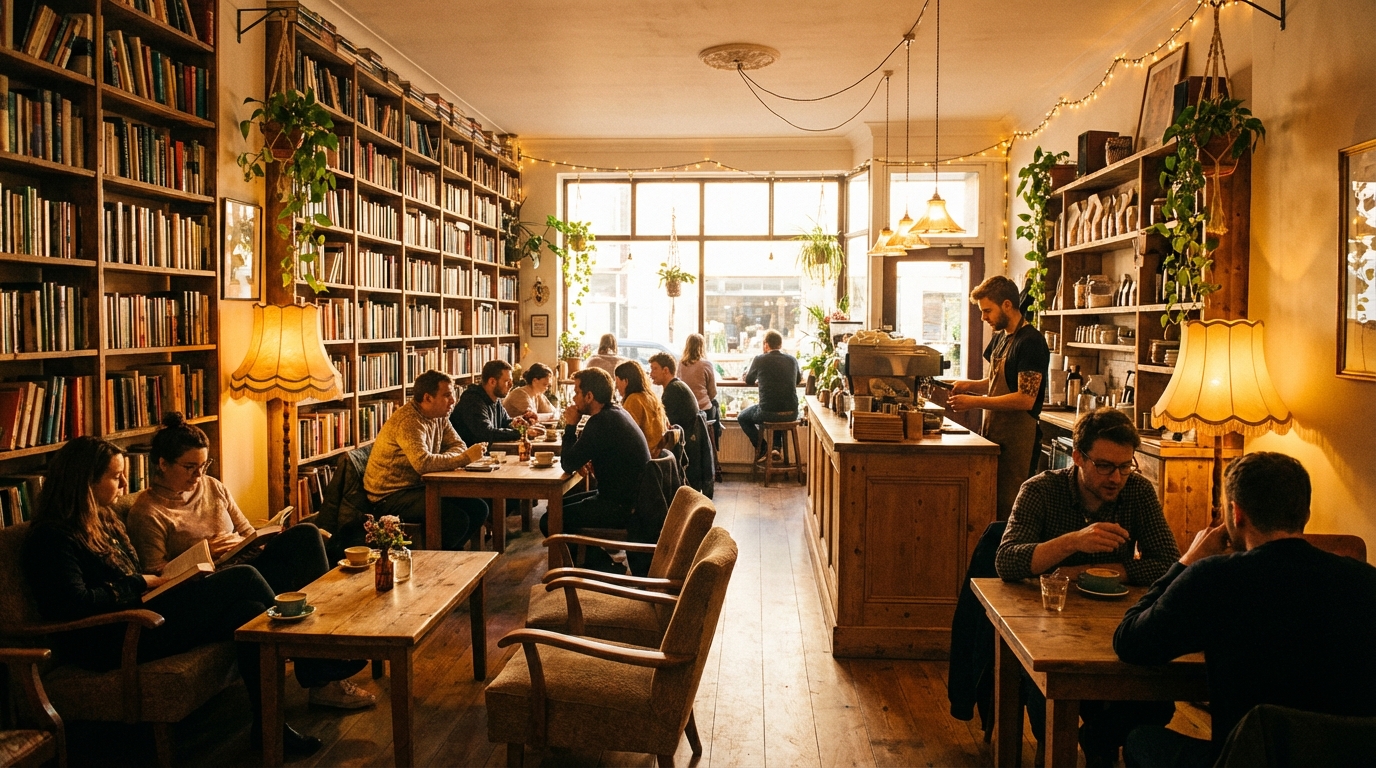
Have you ever noticed that some places make you feel welcome without anyone needing to say a word? That there are spaces where you can sit alone without feeling lonely, or meet friends without scheduling an appointment? This phenomenon has a name, a sociological foundation, and a long history. Welcome to the concept of the third place.
What is the third place?
In 1989, American sociologist Ray Oldenburg published The Great Good Place, in which he presented an idea that would transform how we think about urban spaces. Oldenburg argued that healthy community life depends on three types of environment.
The first place is the home, the private space where we live and build our intimate lives. The second place is work, where we carry out our professional duties and spend much of our day. The third place is a public or semi-public space, different from the other two, where people voluntarily meet to socialize, converse, and simply be.
Oldenburg identified that throughout history, these third places have been fundamental to social cohesion. The Parisian cafes of the 18th century, English pubs, Italian piazzas, and American barbershops all served this role. When these spaces disappear or weaken, community life suffers.
The eight characteristics of a third place
Oldenburg did more than name the concept. He described eight characteristics that define an authentic third place.
Neutral ground
The third place is a space where no one is host or guest. Everyone is on equal footing. No one is obligated to be there, and no one needs to invite or be invited. This neutrality eliminates hierarchies and facilitates spontaneous interactions.
Social leveler
In the third place, distinctions of class, profession, and social status lose relevance. What matters is presence and willingness to interact. A teacher, a construction worker, and a business owner can share the same table without any of them feeling out of place.
Conversation as the main activity
The primary activity in a third place is conversation. One does not go to a cafe primarily to consume coffee, but to be among people. Coffee is the means, not the end. Lively discussions, exchange of ideas, debates, and even shared silences are the essence of the space.
Accessibility and accommodation
A good third place is easy to reach, has convenient hours, and does not impose barriers to entry. No membership is required, no reservations needed, no dress code enforced. The door is open.
Regular patrons
Every third place has its regulars, people who frequent the space consistently and who, over time, create an informal community. These regulars give personality to the place and welcome newcomers. They are the living memory of the space.
Low profile
The third place is neither ostentatious nor exclusive. Its appearance is unpretentious, without intimidating luxury. This simplicity is intentional: it communicates that everyone is welcome, regardless of financial status.
Playful atmosphere
The predominant tone is one of lightness and good humor. Even when serious topics are discussed, there is an atmosphere of warmth. People feel comfortable laughing, disagreeing, and returning the next day.
A home away from home
Perhaps the most poetic characteristic: the third place offers the warmth and comfort of home, but with the advantage of diversity. It is a space where you belong without anyone needing to say so explicitly.
Why coffee shops became the modern third place
Since the cafes of Vienna and Paris in the 18th century, coffee shops have played the role of third place with mastery. There is something about the combination of coffee, shared tables, and unhurried time that naturally fosters togetherness.
In the contemporary context, coffee shops have gained even more relevance. Remote work has dissolved the boundaries between the first and second place. Many people work from home, and the distinction between personal and professional space has blurred. The third place then becomes both a practical and emotional necessity: a space that is neither home nor office, where it is possible to recover lost sociality.
Furthermore, in cities marked by inequality and spatial segregation, an accessible coffee shop functions as a rare democratic meeting point. Students, retirees, remote workers, artists, and travelers share the same environment, each with their own rhythm, but all contributing to the collective energy.
How Consciencia Cafe embodies the concept
Consciencia Cafe was born with the vocation to be more than a coffee shop. From the conception of the space, design and programming decisions were guided by the principles of the third place.
The community library
One of the hallmarks of Consciencia Cafe is the bookshelf available to anyone. You do not need to be a customer to browse a book. This deliberate choice transforms the space into a permanent invitation to stay and discover. Reading, combined with coffee, creates an environment that stimulates both introspection and conversation.
Events and gatherings
The events calendar at Consciencia Cafe includes chess nights, discussion circles, literary meetups, and guided coffee tastings. Each event is designed to be accessible and requires no prior knowledge. The goal is not to impress but to include. These regular moments create rhythm and predictability, two essential ingredients for a space to become a habit.
The coworking area
The coworking area acknowledges a contemporary reality: many people need a flexible second place that is neither the traditional office nor the isolation of home. By offering tables, internet, and, of course, quality coffee, Consciencia creates the conditions for work to happen within a community, rather than apart from it.
Space design
Tables are arranged to facilitate both individual work and interaction. There are seats for those seeking quiet and corners for those wanting conversation. The lighting is warm, music is present but not intrusive, and the staff is trained to welcome without pressuring.
The third place in the digital age
Some might argue that social media has replaced physical third places. Oldenburg would disagree. Physical presence, eye contact, the serendipity of an unplanned encounter: these are qualities that no digital platform can replicate. The third place demands bodies, physical space, and shared time.
However, the digital can complement the physical. A community that forms around a coffee shop can maintain contact online between visits, share reading recommendations, or coordinate schedules for a coffee. The important thing is that the in-person experience remains at the center.
The value of having somewhere to go
In a world that frequently pushes us toward isolation, whether through remote work, screens, or the very dynamics of large cities, having a third place is both a privilege and a necessity. It is a space where solitude is not imposed, where chance can become friendship, and where the quiet presence of other human beings reminds us that we belong to something larger.
If you are exploring Foz do Iguacu, perhaps after visiting the breathtaking Iguazu Falls or crossing the Friendship Bridge to Ciudad del Este, you will find that the city has its own special corners. The Triple Border region is a place of cultural convergence, and Consciencia Cafe reflects that spirit.
Visit Consciencia Cafe and discover what it means to have a third place. Bring a book, a friend, or just yourself. The table is set, and the coffee is fresh.