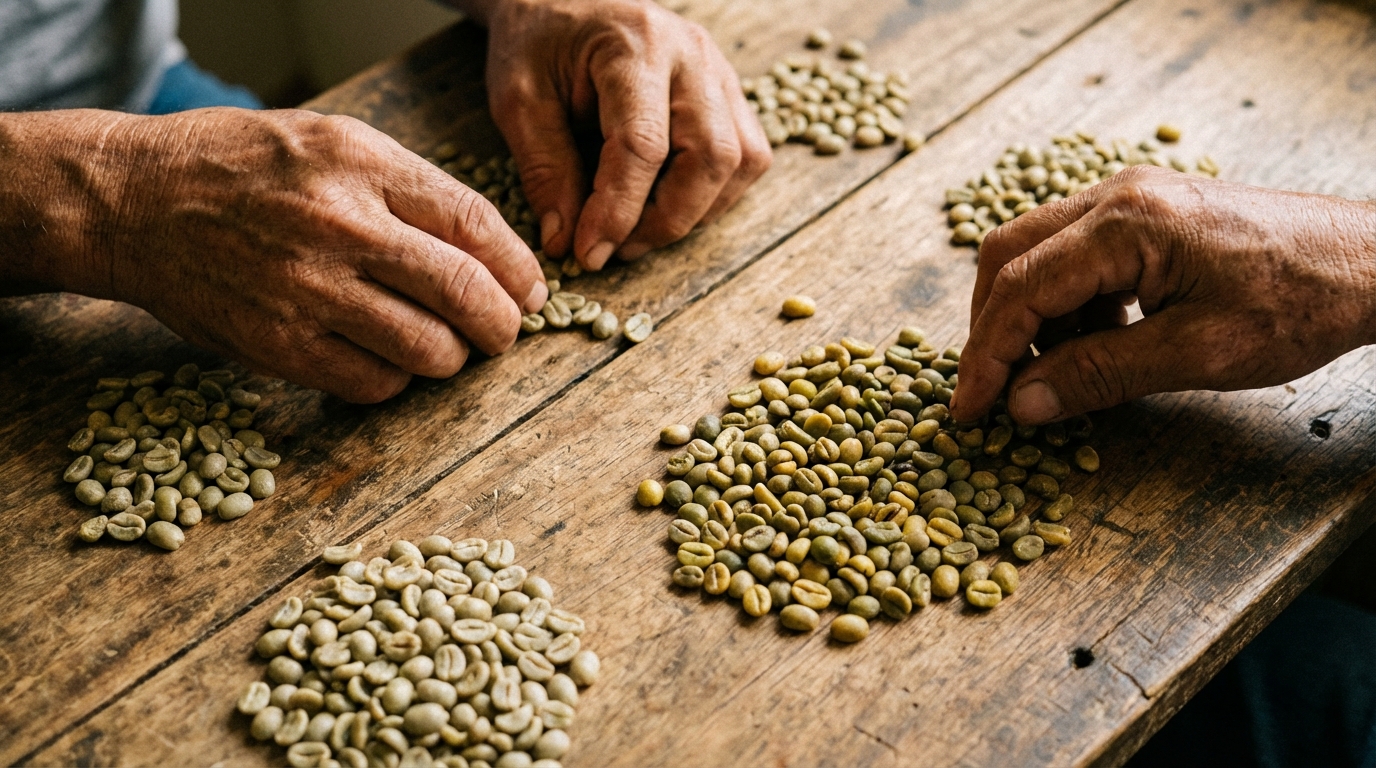
Coffee Sorting: How Bean Grading Ensures Quality
When you drink a cup of specialty coffee, every clean and balanced sip is the result of work that begins long before roasting. One of the most critical stages — and least known to consumers — is sorting: the process of separating defective beans from healthy ones. It may sound simple, but this meticulous selection is what defines the boundary between mediocre coffee and an exceptional one.
What Is Coffee Sorting
Coffee sorting is the process of inspecting and separating raw (green) coffee beans with the goal of removing those that present physical or sensory defects. In practice, sorting functions as a quality filter. Even the best coffees, grown in exceptional terroirs and harvested at the ideal point of ripeness, may contain problematic beans. Pests, climate variation, drying failures, or transport issues can introduce defects that, if not removed, will compromise the flavor in the cup.
Sorting can be done manually, by trained operators who examine bean by bean, or electronically, by sophisticated machines using optical sensors. In many specialty coffee roasteries, both methods are combined.
Primary Defects: The Cup’s Greatest Enemies
Defect classification in coffee follows standardized methodologies, such as those from the Specialty Coffee Association (SCA) and official Brazilian grading systems. Defects are divided into two categories: primary and secondary. Primary defects are the most serious — a single bean with a primary defect can compromise an entire cup.
Black beans
A black bean is completely darkened, the result of excessive fermentation in the fruit while still on the plant or after harvest. It can occur when fruit drops to the ground and rots before being collected, or when drying is inadequate.
In the cup, a black bean produces fermented, acrid, and extremely unpleasant flavors. A single black bean in a 300-gram sample is enough to be detected during cupping.
Sour beans
Sour beans present a reddish-brown to dark-brown coloration, the result of partial fermentation. Less extreme than black beans, they are still very harmful. The flavor they contribute is negatively acidic, with vinegar-like notes and astringency.
The most common cause is delay between harvest and the start of processing. Fruit that remains piled too long, especially in hot and humid weather, begins to ferment undesirably.
Stones and foreign matter
It may seem unusual, but stones, twigs, clumps of soil, and other foreign materials are found in coffee lots with some regularity. These contaminants not only affect flavor (soil can impart a moldy taste) but can damage grinders and even injure consumers.
Immature green beans (quakers)
Beans harvested before the ideal point of ripeness maintain a greenish coloration even after processing. During roasting, these beans do not adequately develop Maillard reactions, resulting in vegetal, astringent flavors with notes of grass and raw pea.
The presence of immature beans indicates non-selective harvesting — when the entire plant is stripped at once, regardless of the ripeness of individual fruit.
Moldy beans
Beans contaminated by fungus present whitish or yellowish spots and may contain mycotoxins, substances potentially harmful to health. Beyond the health risk, moldy beans produce flavors of must and damp earth.
Secondary Defects: Less Severe, But Cumulative
Secondary defects individually have less impact than primary ones, but in quantity they can significantly degrade cup quality.
Insect-damaged beans
Insect-damaged beans have been bored by the coffee berry borer (Hypothenemus hampei), an insect that is the primary pest in global coffee cultivation. The insect creates small tunnels inside the bean, depositing eggs and feeding.
Visually, a bored bean presents one or more circular holes with clean edges. Depending on the extent of damage, it may be classified as a secondary defect (superficial holes) or primary (extensive damage with presence of excrement).
In the cup, the borer can contribute fermented flavors and an unpleasant bitterness, depending on severity.
Broken beans
Beans that fractured during mechanical processing (hulling, pulping) or transport. Broken beans roast unevenly — exposed edges burn while the interior remains underdeveloped, contributing burnt notes and bitterness.
Shell beans (ears)
Shell beans are a malformation where the two halves of the bean separate, resulting in a thin, concave shell. Being much thinner than a normal bean, it roasts much faster and darkens well before the rest, adding burnt notes to the lot.
Faded beans
Faded beans have an opaque brown coloration, the result of excessive or prolonged drying. They have lost most of their aromatic compounds and, in the cup, contribute a woody, insipid, and lifeless flavor.
Husk (parchment)
Fragments of the fruit skin or parchment (the layer surrounding the bean) that were not completely removed during processing. During roasting, these husks burn quickly and can release ash particles.
Screen Grading: Size Matters
Beyond defect separation, green coffee is classified by size using a screen system — metal plates with holes of standardized diameters.
How it works
Coffee is passed through a series of stacked screens, from largest to smallest. Each screen has a number corresponding to a specific diameter, measured in fractions of an inch:
- Screen 18: holes of 18/64 inch (7.14 mm) — large beans
- Screen 17: holes of 17/64 inch (6.75 mm)
- Screen 16: holes of 16/64 inch (6.35 mm) — medium beans
- Screen 15: holes of 15/64 inch (5.95 mm)
- Screen 14: holes of 14/64 inch (5.56 mm) — small beans
Beans are retained on the screen that corresponds to their size. Beans retained on screens 16 and above are generally classified as “large,” while screens 14 and 15 are “small.”
Why size matters
Size uniformity is fundamental for even roasting. When all beans in a lot are similarly sized, they absorb heat at the same rate and develop aromatic compounds uniformly. Beans of very different sizes in the same lot result in simultaneous under and over-roasting.
Additionally, larger beans (screens 17 and 18) are frequently associated with higher-quality coffees, although this correlation is not absolute. Larger beans tend to come from better-nourished, riper fruit, but exceptional coffees with smaller beans do exist.
Flat beans versus peaberries
Beyond diameter, beans are separated by shape:
- Flat: the normal bean, with one flat face and one convex face. This results when the coffee fruit develops two seeds
- Peaberry: the rounded bean, formed when the fruit develops only one seed instead of two. Peaberries are separated using specific screens and often marketed as special lots, as they are believed to concentrate more flavor
Manual Versus Electronic Sorting
Technological evolution has brought alternatives to manual sorting, but both methods remain relevant in the specialty coffee chain.
Manual sorting
In manual sorting, trained operators examine coffee spread on a table or conveyor belt, removing defective beans by hand. It is meticulous, repetitive work that demands concentration and experience.
Advantages:
- Detects subtle defects that machines may miss
- Allows contextual judgment (a marginal defect in a high-scoring lot may be removed as a precaution)
- Does not require investment in expensive equipment
Limitations:
- Slow: an experienced person processes only a few kilograms per hour
- Subject to fatigue and human inconsistency
- Labor cost at scale
Electronic sorting (optical sorter)
An optical sorter is a machine that analyzes each bean individually using high-speed cameras and sensors. Beans pass single-file through a chute, are photographed by multiple cameras, and artificial intelligence algorithms compare each bean’s image against programmed quality parameters. Defective beans are ejected by jets of compressed air in milliseconds.
Advantages:
- Speed: processes hundreds of kilograms per hour
- Consistency: does not suffer from fatigue
- Precision: detects color variations invisible to the human eye, including internal defects when equipped with infrared sensors
Limitations:
- High acquisition and maintenance cost
- May eject good beans in marginal cases (false positives)
- Depends on correct calibration for each lot
The ideal combination
In practice, specialty coffee roasteries frequently combine both methods: the optical sorter makes the first pass, removing the majority of defects, and manual sorting provides the final refinement, catching what the machine missed.
Impact on the Final Score
The relationship between sorting and coffee scoring is direct and measurable. The SCA (Specialty Coffee Association) protocol assigns scores from zero to one hundred, and to be classified as specialty coffee, the minimum score is 80 points.
How defects affect scoring
Physical defects directly impact the sensory attributes evaluated during cupping:
- Clean cup: defects like black and sour beans add foreign flavors that can zero out this attribute
- Sweetness: immature and faded beans reduce the perception of sweetness
- Uniformity: irregular presence of defects creates inconsistency between cups
- Flavor and aftertaste: defects introduce unwanted bitterness and unpleasant aftertaste
Under SCA classification, a 350-gram sample of green coffee may have zero primary defects and a maximum of five secondary defects to be considered “Specialty Grade.” The next category down, “Premium Grade,” allows up to eight secondary defects.
The mathematics of quality
Consider two lots of the same coffee, same terroir, same harvest. Lot A undergoes rigorous sorting and has zero defects. Lot B has negligent sorting and contains six black beans in 350 grams. In sensory evaluation, Lot A may score 86 while Lot B drops to 72 — the difference between specialty coffee and commercial coffee.
This is the importance of sorting: it does not create quality, but it protects the quality that already exists. A coffee with potential for 88 points can fall to 75 if sorting is careless.
The Quality You Do Not See
Sorting is one of those stages invisible to the end consumer. You do not see the operators examining beans under intense light, nor the optical sorters firing jets of air at each defective bean. But you feel the result in every sip — in the absence of off-flavors, in the cleanness of the cup, in the sweetness and clarity that only well-sorted coffee can deliver.
It is behind-the-scenes work that deserves recognition. Because in specialty coffee, quality is not only what is present — it is also what has been carefully removed.
Visit Consciencia Cafe and taste the difference that careful sorting makes. Whether you are here to explore Iguazu Falls or the Triple Border, every bean that reaches your cup has passed through a rigorous grading process, ensuring you receive only the best from each lot.