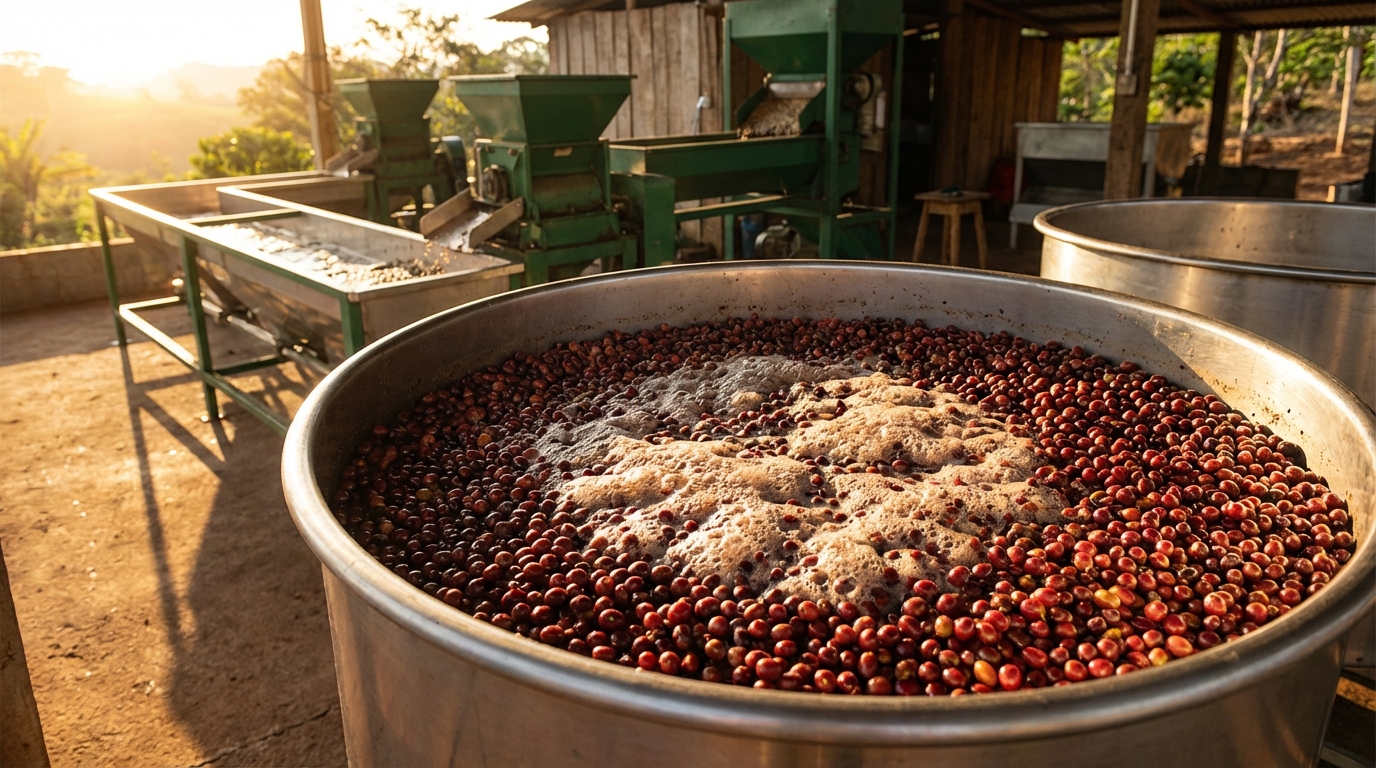
In recent years, a quiet revolution has been transforming specialty coffee. Producers, agronomists, and food scientists are exploring fermentation techniques that go far beyond traditional methods, producing coffees with flavors that challenge everything we imagined possible in a cup. Notes of strawberry, champagne, spices, red wine, and even aged cheese are appearing in coffees processed with experimental techniques.
But before diving into these innovations, it is worth reviewing the fundamentals. What exactly is fermentation in the context of coffee, and how did traditional methods pave the way for this new era?
A quick review: the classic processes
Natural (dry)
In the natural process, coffee cherries are harvested and dried whole, with the pulp still surrounding the seed. During drying, which can take 15 to 30 days on patios or African raised beds, the pulp ferments naturally around the bean. This prolonged fermentation transfers sugars and aromatic compounds from the pulp to the seed, resulting in coffees with full body, pronounced sweetness, and intense fruity notes.
The natural process is one of the oldest and is widely used in Brazil and Ethiopia. When well executed, it produces exuberant coffees. When poorly managed, it can generate off-putting fermented and vinegar-like flavors.
Washed (wet)
In the washed process, the pulp is mechanically removed shortly after harvest, and the beans, still covered with a layer of mucilage, are placed in water tanks. Fermentation happens in these tanks, typically for 12 to 36 hours, with the goal of dissolving the mucilage. After fermentation, the beans are washed and dried.
This method produces cleaner coffees, with bright acidity and greater clarity of notes. It is the predominant method in Colombia, Central America, and parts of East Africa.
Honey
The honey process is a middle ground. The pulp is removed, but part of the mucilage is kept on the bean during drying. Depending on how much mucilage is preserved, the coffee is classified as yellow honey (little), red honey (medium), or black honey (a lot). The result is coffee with elevated sweetness, medium to full body, and aromatic complexity.
Anaerobic fermentation
The principle
In anaerobic fermentation, coffee beans, with or without pulp, are placed in hermetically sealed containers such as stainless steel tanks or barrels. By eliminating oxygen from the environment, the producer creates conditions for only anaerobic microorganisms to act on the mucilage and pulp.
This environmental control radically changes the fermentation profile. Under normal aerobic conditions, a wide variety of bacteria and yeasts compete for available sugars, producing a diverse but not always predictable spectrum of byproducts. In the absence of oxygen, specific strains of lactic acid bacteria predominate, producing lactic acid and aromatic compounds that give the coffee more complex and controlled notes.
Time and temperature
Anaerobic fermentation typically lasts between 48 and 96 hours, though some producers experiment with even longer periods. Temperature is carefully monitored, generally kept between 18 and 22 degrees Celsius. Lower temperatures slow microbial activity, resulting in longer fermentations and more delicate flavors. Higher temperatures accelerate the process, producing more intense notes but with greater risk of defects.
Sensory results
Coffees processed through anaerobic fermentation frequently present a striking sensory profile: wine-like acidity, silky body, notes of ripe red fruits, spices such as cinnamon and clove, and a long, complex finish. Some of these coffees resemble natural wines in their intensity and uniqueness.
Carbonic maceration
Borrowed from wine
Carbonic maceration is a well-established technique in winemaking, particularly in the production of Beaujolais wines in France. In the coffee context, it was adapted and popularized by innovative producers in Colombia, Costa Rica, and Brazil.
The process works as follows: whole coffee cherries are placed in a sealed tank. The tank is injected with carbon dioxide (CO2), displacing residual oxygen. Fermentation happens inside each cherry individually, as the fruit’s natural enzymes break down sugars in the absence of external oxygen.
Difference from anaerobic
While in anaerobic fermentation environmental microorganisms drive the process, in carbonic maceration the focus is on intracellular enzymatic action. The injected CO2 creates pressure that modifies the cherry’s cellular behavior, producing a distinct aromatic profile.
Sensory profile
Coffees from carbonic maceration tend to present bright and vivid acidity, intense floral notes, tropical fruits like passion fruit and lychee, and a sweetness reminiscent of honey or muscovado sugar. The texture is frequently described as juicy, with a freshness that lingers on the palate.
Selected yeasts
The newest frontier
If anaerobic and carbonic fermentations control the environment, the use of selected yeasts goes one step further: it controls the very agents of fermentation. Instead of relying on yeasts and bacteria naturally present on the beans and in the environment, the producer inoculates specific strains chosen for their aromatic potential.
Saccharomyces and beyond
The most commonly used yeast is Saccharomyces cerevisiae, the same species employed in beer, wine, and bread production. Different strains of this species produce distinct aromatic profiles. One strain might emphasize tropical fruit notes, while another favors spice or floral notes.
Beyond Saccharomyces, producers are experimenting with other yeast species and even combinations of yeasts and lactic acid bacteria, creating what might be called mixed-culture fermentations, analogous to Belgian sour beers.
Unusual notes
The use of selected yeasts has produced coffees with sensory notes that defy expectations. Coffees have been documented with notes of strawberries in syrup, ripe mango, jasmine, cinnamon, ginger, and even champagne. These profiles are so distinct that in blind tastings, some cuppers do not immediately recognize them as coffee.
This ability to produce such unusual flavors raises interesting questions about identity. To what extent can a coffee depart from what we understand as coffee flavor and still be appreciated as such? The answer, for most industry professionals, is that this diversity is precisely what makes specialty coffee so fascinating.
Controversies and challenges
Not everyone in the specialty coffee world receives experimental fermentations with uniform enthusiasm. Some argue that the process can mask the intrinsic quality of the bean, functioning almost like flavoring. Others question reproducibility: how can an extremely specific fermentation be replicated harvest after harvest?
These are valid concerns. The industry’s response has been to pursue greater scientific rigor, with monitoring of pH, Brix (sugar concentration), temperature, and microbial composition throughout the entire process. The more data the producer collects, the more predictable and replicable the result becomes.
The future of fermentation
Experimental fermentation is only at the beginning of its potential. As food science advances and more producers gain access to monitoring equipment and yeast strains, the diversity of flavors available in a cup of coffee will continue to expand. We are living through a moment when coffee is approaching the complexity and sophistication that wine took centuries to develop.
For visitors to the Triple Border region, tasting these innovative coffees provides a window into the cutting edge of what the coffee world has to offer. Foz do Iguacu, with its position at the crossroads of three South American coffee cultures, is an ideal place to explore these new flavors.
Visit Consciencia Cafe and taste coffees processed with innovative fermentation techniques. Every bean tells a story of science, creativity, and flavor.