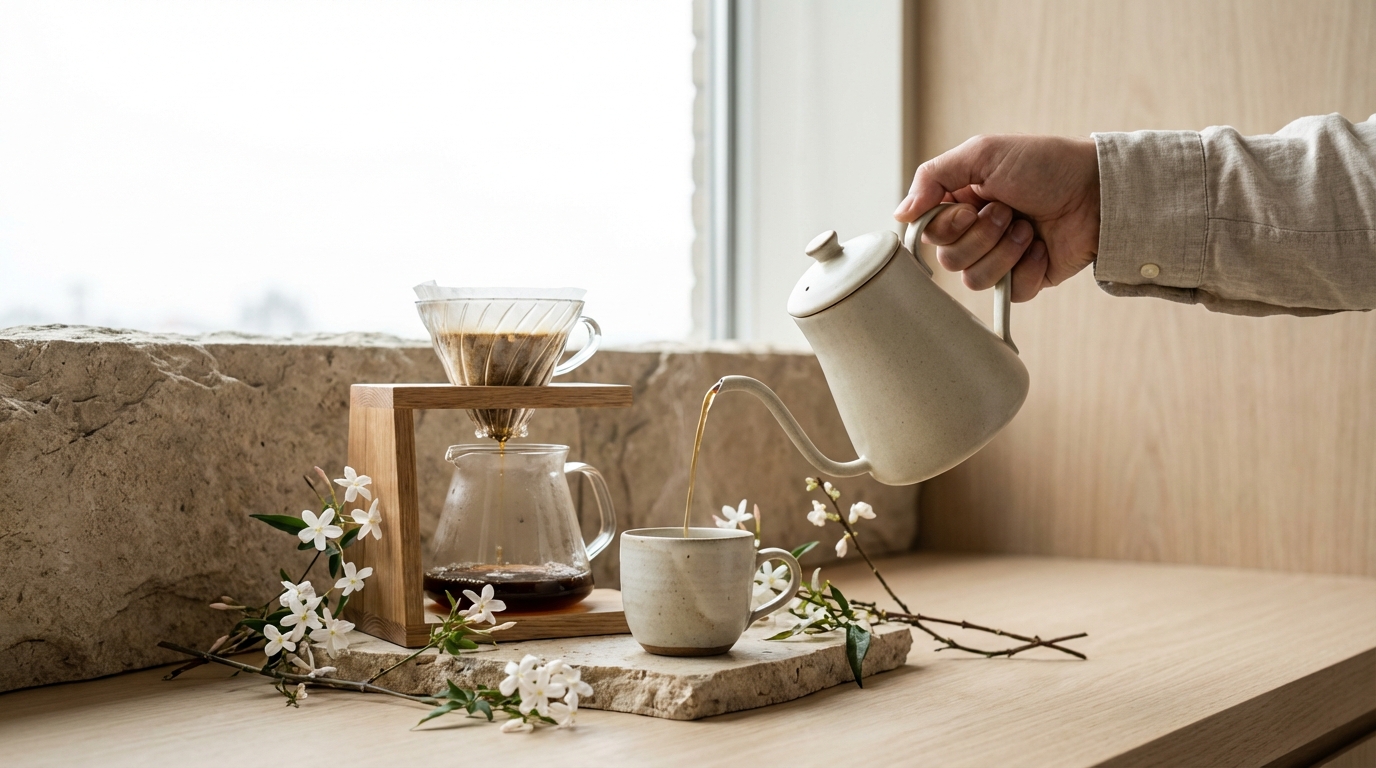
There is a coffee that sells for hundreds, sometimes thousands of dollars per pound. A coffee that tasters describe with words normally reserved for fine perfumes: jasmine, bergamot, orange blossom, ripe peach. A coffee that transformed a farm in Panama into a global reference and redefined what the world expects from an exceptional cup. That coffee is Geisha.
But what makes Geisha so special? The story of this bean is a fascinating journey that crosses continents and decades, and understanding it helps answer the question many people ask: is it really worth the price?
The origin: from Ethiopian forests to the world
The birthplace in the Gesha region
Geisha coffee, also spelled Gesha, originates from the forests of the Gesha region in southwestern Ethiopia. There, the plant grows wild at high elevations, between 1,700 and 2,000 meters above sea level, sheltered by the canopy of native trees. This is the ancestral homeland of arabica coffee, where the species evolved over millennia developing a genetic complexity that no other producing region can naturally replicate.
In the 1930s, researchers collected seeds from this variety and sent them to research centers in Tanzania and Costa Rica as part of genetic improvement programs focused on disease resistance, particularly coffee leaf rust.
The arrival in Panama
The Geisha variety arrived in Panama in the 1960s but remained virtually ignored for decades. Producers considered it unproductive compared to varieties such as Caturra and Catuai. The plant is tall, with long and spaced branches, and produces significantly fewer fruits per area. Economically, it made no sense.
Everything changed in 2004 when the Peterson family, owners of Hacienda La Esmeralda in the Boquete region, decided to separate and individually process lots from different varieties cultivated on the farm. When the Geisha lot was cupped separately, the tasters were astonished. The sensory profile was something they had never experienced in coffee from Panama, or anywhere else.
The moment that changed everything: Best of Panama 2004
Hacienda La Esmeralda entered its Geisha lot in the 2004 Best of Panama competition, the country’s most prestigious coffee contest. The result was historic: the Geisha not only won but achieved scores that shattered records. In the subsequent auction, the lot sold for a price far exceeding any other Panamanian coffee up to that point.
This event marked the beginning of the Geisha era. In the following years, the coffee continued breaking records at the Best of Panama and in international auctions, reaching values that had seemed unimaginable for an agricultural product.
Auction records
The prices reached by Geisha at auction are staggering. In recent years, exceptional lots from Hacienda La Esmeralda and other Panamanian farms have surpassed one thousand dollars per pound. In 2023, a washed Geisha lot from Esmeralda reached over 6,000 dollars per pound at the farm’s private auction.
These figures may seem absurd, but context is important: these are tiny micro-lots, often only a few dozen kilograms, purchased by elite roasters and coffee collectors seeking unique sensory experiences. The Geisha that reaches specialty cafes in larger quantities is priced significantly more accessibly, though still at a premium.
The sensory profile: why it is so different
Floral, citric, complex
What makes Geisha immediately recognizable is its intensely floral aromatic profile. While most specialty coffees present subtle floral notes as part of a broader set, in Geisha these notes take center stage. Jasmine is the most common descriptor, followed by bergamot, orange blossom, and lavender.
Beyond flowers, Geisha frequently displays notes of delicate fruits: white peach, mango, passion fruit, and tropical fruits. The acidity is bright and elegant, more reminiscent of a fine tea than a conventional coffee. The body tends to be silky and light, with a long, perfumed finish that lingers on the palate.
The influence of terroir and processing
Geisha’s profile varies considerably depending on where and how it is produced. Geishas cultivated at extreme altitudes in Panama, above 1,800 meters, tend to be more floral and complex. Geishas from Colombia and Ethiopia present distinct profiles, often with more fruit and fewer of the classic Panamanian floral notes.
The processing method also profoundly influences the result. Washed Geisha tends to be cleaner and more floral. Natural Geisha, dried with the fruit intact, develops intense sweetness and fermented fruit notes. Honey process, a middle ground, can combine the clarity of washed with the sweetness of natural.
Why it is so expensive: the economics of Geisha
Low productivity
The Geisha plant produces significantly fewer fruits than commercial varieties. Where a Catuai tree can yield 30 to 40 bags per hectare, Geisha frequently produces fewer than 15. This means the production cost per kilogram is much higher, even before considering any market premium.
Delicate management
Geisha requires specific care in cultivation. The plant is more susceptible to certain pests and diseases, requires adequate shade, and thrives best at high elevations where climatic conditions are more challenging for the farmer. The harvest, often manual and selective, adds further cost to the process.
Meticulous processing
Farms that produce high-scoring Geisha invest in extremely careful processing. Every stage, from harvest to drying, is monitored with rigor. Lots are separated by altitude, terrain orientation, and harvest day. This level of attention to detail is expensive, but it is what allows achieving scores above 90 on the SCA scale.
Growing global demand
The specialty coffee market has grown enormously over the past decade, and Geisha has become the benchmark bean for those seeking the pinnacle of sensory experience. Demand consistently exceeds supply, which sustains the elevated prices.
Is it worth the price?
This is a subjective question, and the answer depends on what you seek in your coffee experience.
For whom it is worth it
If you are a curious enthusiast who wants to understand the limits of what coffee can offer in terms of aromatic complexity, tasting a Geisha is a revelatory experience. It is like visiting an art gallery after years of seeing reproductions: the difference between reading about jasmine notes and feeling them on your palate is transformative.
A perspective on value
It helps to think of Geisha compared to other luxury products. A serving of high-scoring Geisha at a specialty cafe might cost the equivalent of a glass of premium wine at a restaurant. From this perspective, it is not an absurd price for a genuinely unique sensory experience.
For whom it may not be worth it
If you are just beginning your journey into specialty coffee, it may make more sense to first explore the diversity of origins and processes available at more accessible price points. An excellent coffee from Ethiopia, Colombia, or Brazil itself can offer extraordinary experiences at a fraction of the price of an auction Geisha.
Geisha beyond Panama
Although Panama remains the reference, Geisha is now cultivated in numerous countries. Colombia, Costa Rica, Guatemala, Honduras, and even Brazil have producers experimenting with the variety. Ethiopia, the original birthplace of the plant, has also begun to value and separate its native Geishas.
Each terroir imprints distinct characteristics on the bean, creating a diversity within the variety itself that captivates tasters and challenges the notion that Geisha represents a single, monolithic profile.
Conclusion: more than a coffee, an experience
Geisha has transcended the coffee category to become a sensory experience comparable to great wines and spirits. Its story, from the Ethiopian forest to the Panamanian podium, is a narrative of rediscovery that shows how coffee’s biodiversity still holds extraordinary surprises.
Whether it is worth the price is a personal decision. But if you have the opportunity to taste a well-prepared Geisha, set aside a moment of full attention. Close your eyes, appreciate the aroma before the first sip, and let your palate explore each layer. You will understand why this bean conquered the world.
Visit Consciencia Cafe in Foz do Iguacu and ask our barista about the availability of Geisha coffees and other rare origins. Whether you are exploring the majestic Iguazu Falls or discovering the vibrant Triple Border, we believe every coffee enthusiast deserves to experience the extraordinary at least once.