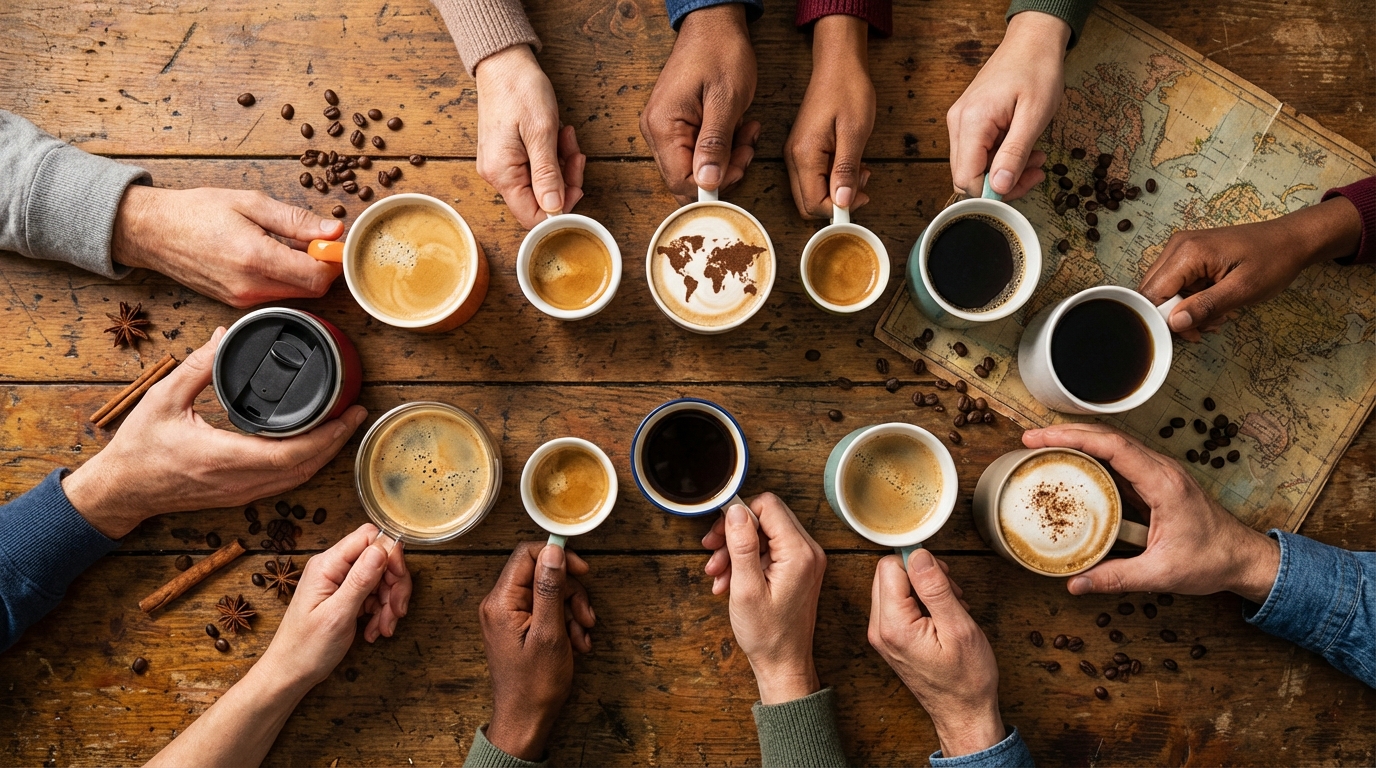
Every October 1st, the world pauses for a moment to celebrate something that billions of people do every day: drink coffee. International Coffee Day, officially established by the International Coffee Organization (ICO) in 2015, is more than a commemorative date. It is a reminder that behind every cup exists a global chain connecting producers in tropical countries to consumers on every continent.
The History of International Coffee Day
Before the Official Date
Long before 2015, several countries already celebrated coffee on their own dates. Japan had been marking the occasion on October 1st since 1983, choosing this date because it marks the beginning of the new coffee harvest in many producing countries. The United States celebrated on September 29th, Ethiopia in December, and Brazil on May 24th, the anniversary of the first coffee seedlings arriving in the country.
The ICO Unification
The International Coffee Organization, an intergovernmental body founded in 1963 that brings together producing and consuming countries, decided to unify these celebrations under a single global date. In March 2014, during a meeting in London, October 1st was established as International Coffee Day. The first official celebration took place in Milan, Italy, in 2015, during Expo Milano, which was dedicated to the theme of food and nutrition.
The Purpose
Beyond celebrating the drink itself, the date was created with concrete objectives: to recognize the work of coffee producers, promote sustainable production and trade practices, and raise consumer awareness about the challenges faced throughout the production chain.
Coffee by the Numbers
The global numbers behind coffee are impressive in scale and reveal the enormous economic and social importance of this beverage.
Production
- The world produces approximately 170 million 60-kilogram bags of coffee per year
- Brazil leads global production, accounting for roughly one-third of the total
- Vietnam is the second-largest producer, followed by Colombia, Indonesia, and Ethiopia
- More than 70 countries cultivate coffee, all located in the tropical band between the Tropics of Cancer and Capricorn
Consumption
- It is estimated that more than 2 billion cups of coffee are consumed daily worldwide
- Finland leads per capita consumption at approximately 12 kilograms per person per year, nearly triple the Brazilian average
- The Nordic countries in general (Norway, Iceland, Denmark, Sweden) rank among the highest per capita consumers
- The United States is the largest consumer market by total volume
- Brazil, despite being the largest producer, ranks approximately fourteenth in per capita consumption
Economic and Social Impact
- The global coffee chain employs more than 125 million people, from farmers to baristas
- International coffee trade generates over 100 billion dollars per year
- In many producing countries, coffee is the primary source of income for entire rural communities
- Roughly 80 percent of the world’s coffee is produced by smallholder farmers with properties of less than 10 hectares
Fascinating Facts You Might Not Know
Finland: The Coffee Capital of the World
It may come as a surprise that the highest per capita coffee consumption is found not in Brazil or Italy, but in Finland. Finns consume an average of four to five cups per day. Coffee consumption is so deeply embedded in Finnish culture that the “kahvitauko,” or coffee break, is a legally protected right in labor relations. The cold climate and long, dark winters certainly play a role, but the tradition goes beyond weather: coffee is the center of Finnish social life.
The Ethiopian Origin
According to the most popular legend, coffee was discovered by a goat herder named Kaldi in Ethiopia around the 9th century. He noticed his goats became more energetic after eating the berries of a certain tree. While the historical accuracy is debated, Ethiopia is indeed the biological birthplace of Arabica coffee, and to this day it harbors a genetic diversity of wild coffee that exists nowhere else on the planet.
Coffee and Revolutions
Coffeehouses, as physical spaces, played fundamental roles in intellectual and political movements throughout history. The cafes of Paris were centers of debate during the Enlightenment and the French Revolution. In London, 17th-century coffeehouses were nicknamed “penny universities” because for a penny you could buy a coffee and gain access to intellectual conversations. In Brazil, the iconic Confeitaria Colombo in Rio de Janeiro was a gathering place for artists and intellectuals who shaped Brazilian culture.
From Second Wave to Third Wave
The recent history of coffee is divided into “waves.” The first wave, from the 19th century through the mid-20th century, democratized consumption with instant and industrialized coffee. The second wave, led by major coffeehouse chains starting in the 1990s, transformed coffee into a social experience. The third wave, which we are living now, treats coffee as an artisanal product, valuing origin, variety, processing, and preparation.
Coffee at the Triple Border
Foz do Iguacu occupies a unique position on the coffee map. At the Triple Border where Brazil, Argentina, and Paraguay meet, three coffee cultures converge:
- Brazil: the world’s largest producer, with a traditional filtered coffee culture that is rapidly evolving toward specialty coffee
- Argentina: where the “cafecito” is a sacred social ritual, enjoyed at any hour, often as a short espresso accompanied by plenty of conversation
- Paraguay: where coffee mingles with the culture of terere and mate, creating a unique relationship between hot and cold beverages
At Consciencia Cafe, we welcome visitors from all three cultures daily, and it is fascinating to see how each person brings their own relationship with coffee. A Brazilian orders a pour-over, an Argentine a cortado, a Paraguayan tries something new. This diversity is what makes our space especially rich, and it gives travelers a truly authentic cultural experience.
How to Celebrate International Coffee Day
You do not need to wait for October 1st to celebrate coffee, but the date is an excellent excuse to do something different:
- Try a coffee from a different origin: if you always drink Brazilian coffee, try a Colombian or Ethiopian
- Change your brewing method: if you use a drip machine, try a manual pour-over or a French press
- Visit a specialty coffee shop: take the opportunity to talk with the barista and learn about the coffee you are drinking
- Research the producer: many specialty coffees include information about the farm and the farmer, a way to acknowledge those who work so that your cup can exist
- Share a coffee: the best way to celebrate a drink that connects people is, precisely, to share it with someone
Special Programming at Consciencia
To celebrate International Coffee Day, Consciencia Cafe prepares a special program:
- Guided tasting of coffees from different origins and processing methods
- Special discounts on filtered methods for those wanting to explore new flavors
- Conversations with our baristas about the coffee production chain
- Surprises for customers who visit us on October 1st
Visit Consciencia Cafe on October 1st and celebrate with us the drink that connects the world. From Ethiopia to Foz do Iguacu, every cup tells a story, and we want to tell the next one with you. Whether you are a local resident or a traveler visiting the magnificent Iguazu Falls, our doors are open.