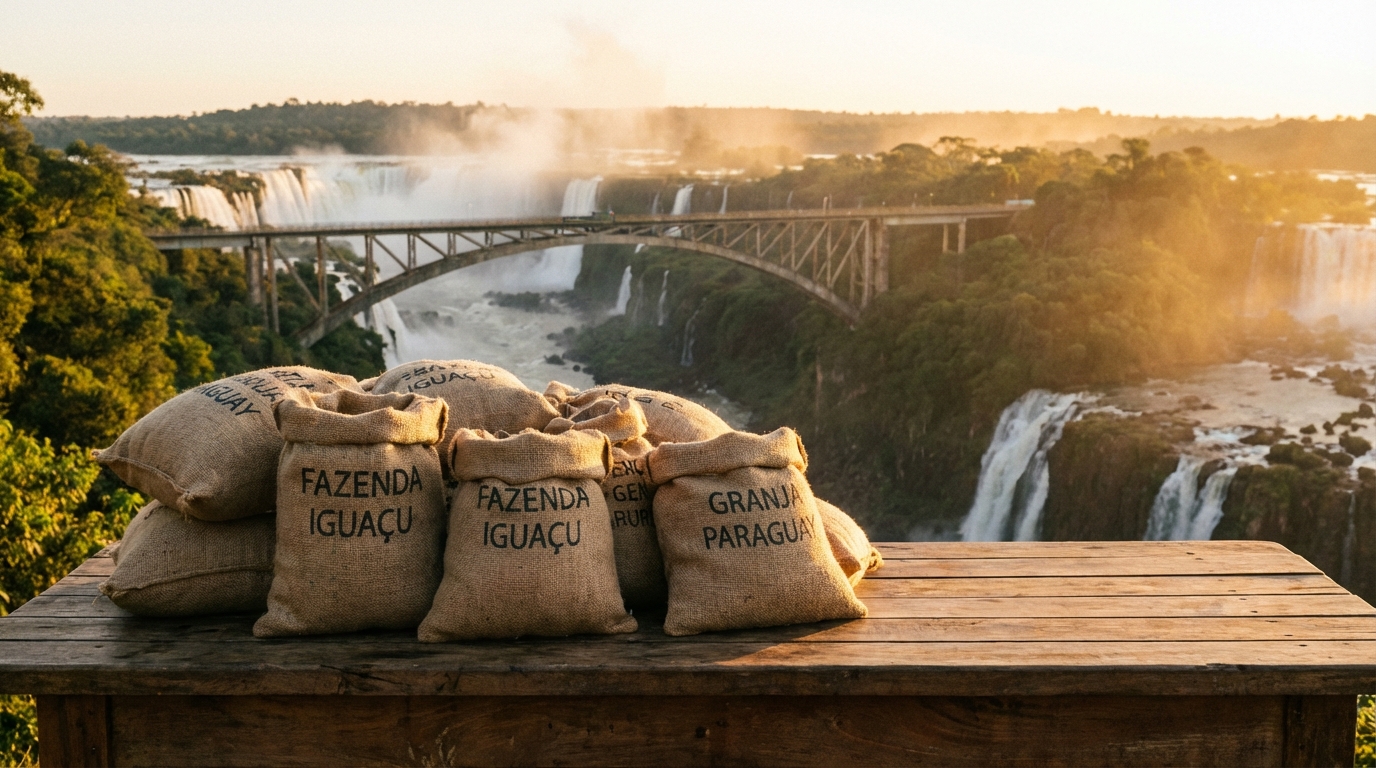
When we opened Consciencia Cafe in Foz do Iguacu, we had a dream that went beyond serving exceptional coffee at the counter. We wanted to bring the Brazilian specialty coffee experience beyond Brazil’s borders, starting from the most natural place possible: the Triple Border, where Brazil, Paraguay, and Argentina meet, separated by nothing more than a river.
Today, our coffee reaches Ciudad del Este and other Paraguayan cities, and this journey has taught us valuable lessons about international logistics, cultural differences in coffee consumption, and the enormous potential of a region that is discovering what specialty coffee can offer.
Why the Triple Border
A unique geography
Foz do Iguacu occupies a privileged geographic position. In less than thirty minutes by car, you can be in three different countries. The Friendship Bridge connects Foz to Ciudad del Este in Paraguay, and the Tancredo Neves Bridge links the city to Puerto Iguazu in Argentina. This proximity creates an intense daily flow of people, goods, and culture that few regions in the world can replicate.
For a specialty coffee business, this geography represents a rare opportunity. Brazil is the world’s largest coffee producer and home to a rapidly maturing specialty coffee scene. Paraguay, right next door, is a market in the early stages of discovering quality coffee. And Argentina, on the other side, has a sophisticated coffee culture concentrated in Buenos Aires but still underdeveloped in the border regions.
Paraguay as first destination
We chose Paraguay as our first international market for practical and strategic reasons. The physical proximity, with Ciudad del Este just fifteen minutes from Foz, drastically reduces costs and logistical complexity. The city has a diverse and cosmopolitan population, with Arab, Asian, Brazilian, and Paraguayan communities that create varied demand for quality products.
Furthermore, the specialty coffee market in Paraguay is at a fascinating early stage. Most consumers are still accustomed to commercial coffee, which means there is enormous room for education and discovery. Every new customer who tastes a coffee scoring above 80 on the SCA scale for the first time experiences that moment of revelation that every specialty coffee professional knows well.
How the coffee reaches Paraguay
Bean selection
The entire process begins with careful bean selection. We work with Brazilian producers from diverse regions, including Minas Gerais, Espirito Santo, and Sao Paulo, prioritizing micro-lots scoring above 82 on the SCA scale. Each lot is cupped and approved by our team before being included in the catalog.
For the Paraguayan market, we take additional care in selection. We understand that the local palate is in transition and that offering extremely complex or acidic coffees right away might repel rather than attract. Therefore, our catalog for Paraguay balances more approachable coffees with chocolate and nut profiles alongside more challenging offerings with fruity and floral notes, catering to different stages of the consumer journey.
Roasting and packaging
Roasting is done in Brazil, with profiles developed specifically for each market. We package in bags with degassing valves and modified atmosphere to preserve freshness during transport and storage. Each package carries complete information about origin, variety, altitude, process, and sensory notes in both Portuguese and Spanish.
Cross-border logistics
This is where theory meets reality. Exporting coffee from Brazil to Paraguay involves a series of bureaucratic steps that, while routine for large exporters, represent a significant challenge for smaller operations.
The documentation includes export invoices, customs clearance, certificates of origin, and phytosanitary documentation. The coffee must cross the Friendship Bridge, pass through Brazilian customs on exit and Paraguayan customs on entry. Each of these checkpoints has its own procedures, schedules, and occasional surprises.
Over time, we developed a logistics workflow that minimizes delays and ensures the coffee arrives at its final destination with freshness preserved. We established partnerships with customs brokers specializing in border operations and created shipping routines aligned with lower-traffic customs hours.
Challenges of B2B operations at the border
Regulatory differences
Brazil and Paraguay have distinct regulations for imported food products. Labeling, nutritional information, product registration, and sanitary standards differ between the two countries. Adapting our packaging and documentation to meet both sets of legislation required investment in specialized consulting and constant iterations.
Exchange rates and pricing
Currency fluctuation between the Brazilian real and the Paraguayan guarani adds a layer of complexity to pricing. Specialty coffee is already a premium product, and when you add export costs, taxes, and margins for local distributors, the final price must be carefully calculated to remain competitive without compromising business sustainability.
We developed a pricing model that absorbs moderate currency fluctuations and review values quarterly to maintain the balance between accessibility for the end consumer and viability for all parts of the chain.
Market education
Perhaps the greatest challenge is not logistical but cultural. Introducing specialty coffee to a market accustomed to commercial coffee requires patience and investment in education. We conduct tastings, barista trainings, and meetings with cafe and restaurant owners to demonstrate the difference specialty coffee makes in the end consumer experience.
This educational work is slow, but the results are lasting. When a barista in Ciudad del Este learns to prepare a V60 correctly and sees customers’ reactions upon tasting a coffee with red fruit notes for the first time, it creates a quality advocate who impacts hundreds of consumers.
Results and lessons learned
Organic growth
Our growth in Paraguay has been deliberately organic. We prefer to serve fewer partners with excellence than many with mediocre quality. Each cafe or restaurant that adopts our coffee receives technical support for preparation, staff training, and educational materials for the end consumer.
This model generates loyalty and genuine referrals. Most of our new partners come through recommendations from existing partners who have seen concrete results in customer satisfaction and market differentiation.
The multiplier effect
Something we did not anticipate, and which has proven extraordinarily positive, is the multiplier effect of education. Baristas we have trained go on to seek knowledge beyond what we offer, participating in competitions, visiting farms, and forming their own learning networks. Specialty coffee creates a culture of curiosity and excellence that propagates on its own.
Vision for the future: an international community
Beyond Paraguay
Our next horizon includes Argentina, specifically Puerto Iguazu and the Misiones region, and potentially other Paraguayan cities beyond Ciudad del Este. Each new market brings its unique challenges, but the experience accumulated at the border has prepared us to navigate this complexity with greater confidence.
A specialty coffee hub at the Triple Border
The long-term vision is ambitious: we want the Triple Border region to be recognized as a specialty coffee hub in South America. Not merely as a consumer market, but as a shaper of opinion and coffee culture. A region where Brazilian, Paraguayan, and Argentine baristas exchange knowledge, where consumers cross borders seeking unique experiences, and where coffee serves as the common language uniting three cultures.
Sustainability and impact
We believe that specialty coffee trade, when conducted with transparency and respect for all parts of the chain, generates real positive impact. Brazilian producers receive fair prices for quality beans. Baristas at the border develop valued skills. Paraguayan and Argentine consumers discover a new dimension of the pleasure of drinking coffee. And the region as a whole benefits from an economic activity that values quality over quantity.
Conclusion: coffee without borders
Coffee has always been a global product. From Ethiopia to the world, it crossed oceans and continents, adapting to every culture that welcomed it. At the Triple Border, this story gains an especially meaningful chapter: three countries united by the aroma and flavor of a product that speaks the universal language of pleasure and quality.
Our journey from Foz do Iguacu to the world is just beginning. Every bag of coffee that crosses the Friendship Bridge carries more than beans: it carries knowledge, passion, and the belief that specialty coffee can transform markets, communities, and experiences.
Visit Consciencia Cafe in Foz do Iguacu and discover firsthand the beans that are crossing borders. Whether you are here to marvel at Iguazu Falls or exploring the vibrant Triple Border region, taste the same coffees that are delighting consumers in Ciudad del Este and learn why Brazilian specialty coffee is one of the best stories this region has to tell.