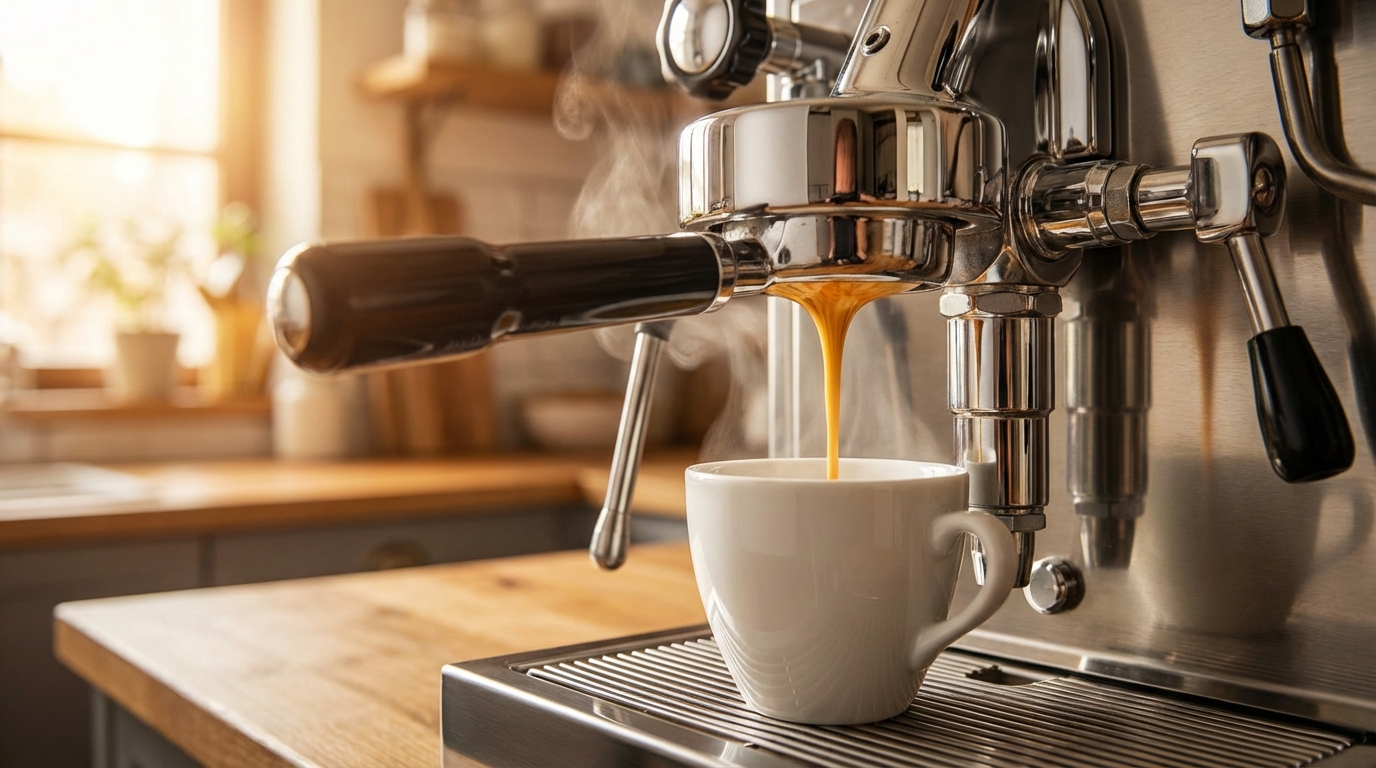
Espresso is, at the same time, the most concentrated and most demanding way to prepare coffee. In just 25 to 30 seconds, pressurized water at high temperature extracts everything the bean has to offer: sugars, oils, acids, and aromatic compounds. When done well, the result is an intense, complex drink with that golden crema that invites the first sip. When done poorly, it can be watery, bitter, or sour.
The good news is that with the right parameters and a bit of practice, you can pull excellent espresso shots at home. This guide covers the fundamentals that make the difference between an ordinary espresso and a memorable one.
The Fundamental Parameters
Espresso depends on four main variables that work together. Changing one affects all the others, so it is important to understand how they relate.
Dose: The Amount of Coffee
The dose is the amount of ground coffee you place in the portafilter of your machine. For most home machines with a 58mm portafilter, the standard dose is:
- 18 to 20 grams of ground coffee for a double espresso
- 8 to 10 grams for a single espresso (less common on home machines)
Use a precision scale with 0.1-gram resolution. It may seem excessive, but a difference of 1 gram in the dose can significantly alter the flavor. Consistency is fundamental: if you use 18 grams today and 20 grams tomorrow, you will never be able to replicate a result you enjoyed.
From the dose, we pursue a ratio between coffee and liquid in the cup. The most common reference for modern espresso is:
- 1:2 ratio — for every gram of coffee, two grams of liquid
- Example: 18 grams of coffee should produce approximately 36 grams of espresso in the cup
This ratio can be adjusted to personal taste. A 1:1.5 ratio produces a more concentrated and sweeter “ristretto.” A 1:2.5 ratio results in something more diluted and mild, called a “lungo.”
Grind Size: The Most Critical Factor
If there is a single factor that most affects espresso quality, it is the grind. It controls the resistance that water encounters as it passes through the coffee, which determines extraction time and, consequently, flavor.
The ideal grind for espresso is fine, with a texture similar to fine beach sand, finer than granulated sugar but not as fine as talcum powder.
Why grind size matters so much
When the grind is too coarse, water passes through the coffee too quickly, without enough time to extract the flavor compounds. The result is a watery, acidic espresso lacking body, what we call under-extraction.
When the grind is too fine, water encounters so much resistance that it extracts too many compounds, including bitter and astringent substances. The result is a dark, bitter, and unpleasant espresso, known as over-extraction.
The importance of the grinder
Investing in a good grinder is as important as investing in the espresso machine itself. Blade grinders (those that look like small blenders) are unsuitable for espresso because they produce particles of very uneven sizes. You need a burr grinder, which can be:
- Manual burr grinder: more affordable, requires physical effort, but produces consistent grinds
- Electric burr grinder with conical or flat burrs: more convenient and precise, with micrometric adjustment
Constant adjustment
Espresso grind is not something you set once and forget. It needs to be adjusted regularly because:
- Ambient humidity affects how ground coffee behaves
- Coffee loses gases after roasting, changing its extraction response over the days
- Different coffees require different grind settings
Extraction Time: The Flavor Clock
The ideal extraction time for a double espresso is:
- 25 to 30 seconds, counted from the moment the machine begins pushing water through the coffee
This time is not arbitrary. In 25 to 30 seconds, with the correct grind, water extracts the ideal amount of soluble solids from the coffee, typically between 18 and 22 percent of the total weight of the ground coffee, which the Specialty Coffee Association considers the ideal extraction range.
If extraction is shorter than 20 seconds, it is likely under-extracted. If it exceeds 35 seconds, it is likely over-extracted.
Water Temperature
Water temperature is the fourth pillar of espresso. The recommended range is:
- 90 to 96 degrees Celsius (194 to 205 degrees Fahrenheit)
Most home espresso machines come configured to operate within this range, but it is worth checking. Higher temperatures extract more quickly and tend to emphasize body and sweetness. Lower temperatures preserve acidity and more delicate notes.
As a general reference:
- Light-roasted coffees benefit from higher temperatures (94 to 96 degrees Celsius)
- Dark-roasted coffees work better with lower temperatures (90 to 92 degrees Celsius)
The Step-by-Step Process
Now that you understand the parameters, here is the practical process:
-
Heat the machine: turn the machine on at least 15 to 20 minutes before use. This ensures the group head, portafilter, and water circuit are at the correct temperature.
-
Weigh the coffee: place the portafilter on the scale, tare it, and add the desired dose (18 to 20 grams).
-
Distribute the coffee: before tamping, distribute the coffee evenly in the portafilter. You can use a WDT (Weiss Distribution Technique) tool, gently tap the portafilter, or use a leveling distributor.
-
Tamp: apply firm, even pressure with the tamper. Excessive force is not necessary; between 15 and 20 kilograms (roughly 30 to 44 pounds) of pressure is sufficient. The most important thing is that the surface is level.
-
Lock in and extract: insert the portafilter into the machine and start the extraction. Place your pre-warmed cup on the scale beneath.
-
Observe and time: monitor the time and the weight of the liquid. Stop the extraction when you reach your desired ratio (for example, 36 grams for an 18-gram dose).
-
Evaluate: observe the crema, take in the aroma, taste. Make mental notes to adjust on the next extraction.
Troubleshooting: What to Do When Things Go Wrong
Thin, sour espresso (under-extraction)
Symptoms: the espresso flows too fast (under 20 seconds), has a light color, little crema, and a sour, watery taste.
Solutions, in order of priority:
- Grind finer: this is the first and most important correction
- Increase the dose by 0.5 to 1 gram
- Check that the water temperature is not too low
- Make sure the tamp is even, with no channels where water could pass without resistance
Bitter, astringent espresso (over-extraction)
Symptoms: the espresso flows too slowly (over 35 seconds), has a very dark color, intense bitter taste, and a dry-mouth sensation.
Solutions, in order of priority:
- Grind coarser: this is the primary correction
- Reduce the dose by 0.5 to 1 gram
- Check that the temperature is not too high
- Ensure you are not tamping with excessive force
Inconsistent espresso (channeling)
Symptoms: the espresso comes out in uneven streams, the flavor mixes acidity and bitterness, and the result differs with each extraction.
This typically indicates that water is finding preferential paths through the coffee (channels) rather than flowing through evenly. Solutions:
- Improve coffee distribution before tamping
- Use a WDT tool (needles to break up clumps)
- Verify the tamper is level
- Check that the portafilter and basket are clean
The Importance of Fresh Coffee
No extraction parameter can compensate for stale coffee. For espresso, ideally use coffee that is:
- Roasted 7 to 30 days ago: very fresh coffee (less than 5 days) is still degassing and can produce uneven extraction. Coffee older than 30 days has already lost much of its volatile aromatic compounds.
- Ground immediately before use: ground coffee begins losing freshness within minutes. Grinding right before extraction is the only way to ensure maximum flavor.
- Stored properly: in an airtight container, away from light and heat, at room temperature.
Practice and Record
The path to perfect espresso is made of repetition and adjustments. Keep a simple log of your extractions: dose, liquid weight, time, grind setting, and a flavor note. In a short time, you will have a clear map of what works for your equipment, your coffee, and your palate.
Visit Consciencia Cafe and talk with our baristas about espresso extraction. We are happy to share tips, demonstrate techniques, and help you elevate your home coffee game. Located in Foz do Iguacu near the breathtaking Iguazu Falls, we welcome coffee enthusiasts from around the world. After all, the more you understand about coffee, the more you appreciate every cup.