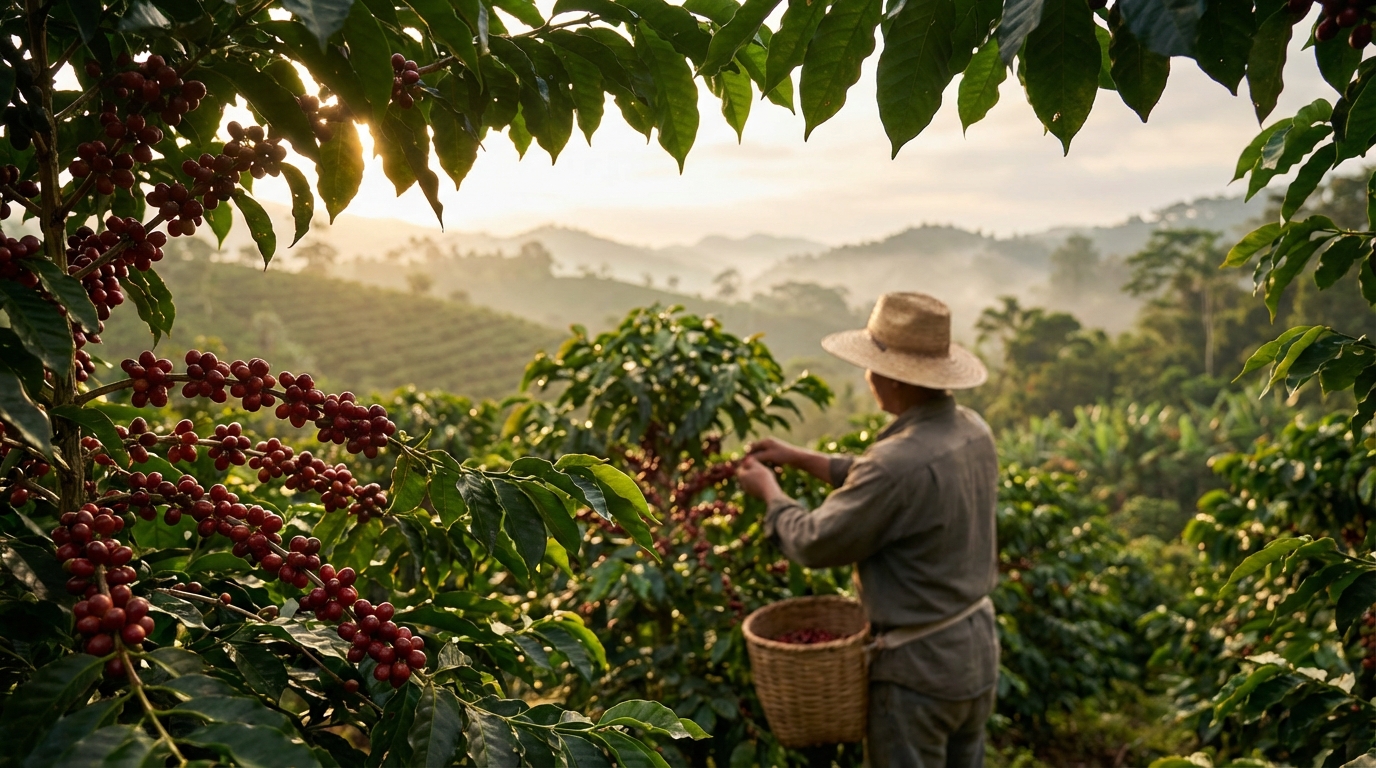
When you buy a bag of coffee, you might find green seals, organization logos, and terms like Rainforest Alliance, Organic, or Fair Trade printed on the packaging. These seals represent certifications that attest to specific production practices, whether environmental, social, or economic. But what does each of them actually mean? And how can you, as a consumer, use this information to make more conscious choices?
In this article, we will unpack the main sustainability certifications in the coffee world, explain their criteria, and discuss their real impacts.
Why do certifications exist?
The coffee supply chain is long and complex. From the farmer who plants and harvests to the consumer who drinks the final cup, there are intermediaries, exporters, importers, roasters, and retailers. In this chain, historically, the producer at the beginning receives the smallest share of the value.
Beyond the economic question, coffee production involves significant environmental challenges. Deforestation to expand growing areas, intensive use of pesticides, excessive water consumption, and soil degradation are real problems in many producing regions.
Certifications emerged as an attempt to create verifiable standards that encourage better practices. A certified farm must meet specific criteria, and independent auditors periodically verify that these criteria are being met. In return, the producer can access differentiated markets and, in some cases, receive premiums above the market price.
Rainforest Alliance
Origin and focus
The Rainforest Alliance was founded in 1987 with a focus on biodiversity conservation and ensuring sustainable livelihoods. Its certification is one of the most globally recognized and uses the icon of a green frog as its seal.
Main criteria
The Rainforest Alliance certification is based on three pillars: environmental, social, and economic. On the environmental pillar, criteria include the conservation of natural ecosystems, protection of waterways, reduction in pesticide use, and maintenance of shade areas and biodiversity within the farm. Certified farms must maintain or restore riparian forests and native vegetation reserves.
On the social pillar, compliance with labor laws is required, along with the prohibition of child labor, access to dignified housing conditions, and workplace safety. On the economic pillar, the certification promotes management practices that increase productivity and profitability in a sustainable manner.
The merger with UTZ
In 2018, the Rainforest Alliance merged with UTZ, another important certification in the coffee market. UTZ, founded in Guatemala in 2002, had traceability and good agricultural practices as its primary focus. Its approach was more oriented toward productive efficiency and transparency in the supply chain.
After the merger, the new unified program kept the Rainforest Alliance name and incorporated the strengths of both certifications. The traceability that was UTZ’s hallmark is now an integral part of the system, allowing consumers to know the origin of the coffee from the farm level.
Real impact
Independent studies show that farms with Rainforest Alliance certification tend to show less forest cover loss, greater use of soil conservation practices, and better working conditions. However, the impact on producer income varies significantly depending on the region and market.
Organic certification
What organic means
A coffee certified as organic was produced without the use of synthetic pesticides, chemical fertilizers, artificial herbicides, or genetically modified organisms. Organic production is based on practices that respect natural cycles, such as composting, crop rotation, biological pest control, and the use of organic fertilizers.
Certifying bodies
Organic certification is regulated by national legislation. In the United States, the standard is USDA Organic. In Europe, European Union regulations define the criteria. In Brazil, the Ministry of Agriculture regulates the system through its Organic Conformity Assessment Program. Each country has its own accredited certifying bodies, and farms wishing to export organic coffee frequently need to obtain multiple certifications to serve different markets.
Transition period
A conventional farm that wishes to become organic must go through a transition period of at least three years. During this period, the producer already follows all organic practices but cannot yet market the coffee with the organic seal. This interval is necessary for residues from previous pesticides to be eliminated from the soil.
Benefits and limitations
Organic production brings clear benefits to the environment: less soil and water contamination, preservation of pollinators, and greater biodiversity. For the consumer, the guarantee of no chemical residues in the final product is an important draw.
However, organic certification alone does not guarantee that the producer receives a fair price. It is possible for organic coffee to be sold at conventional market prices, especially when there is oversupply. Additionally, certification costs can be prohibitive for small producers.
Fair Trade
The fundamental principle
Fair Trade has as its central principle guaranteeing a minimum price to the producer, regardless of market fluctuations. When the market price falls below a defined threshold, the Fair Trade producer continues receiving the minimum price established by the certification.
How it works
Fair Trade certification is granted to cooperatives of small producers, not to large individual farms. This reflects its mission to strengthen the most vulnerable producers. In addition to the minimum price, the certification includes a Fair Trade premium, an additional amount paid per pound of coffee, which the cooperative must invest in community projects such as education, health, or infrastructure.
Social and environmental criteria
Fair Trade also requires compliance with social criteria, such as the prohibition of forced and child labor, respect for freedom of association, and safe working conditions. On the environmental front, it encourages sustainable production practices, though its environmental criteria are generally less rigorous than those of Rainforest Alliance or organic certification.
Criticisms and debates
The Fair Trade system faces criticism. Some economists argue that the minimum price can discourage quality improvement, since the producer receives the same price regardless of bean quality. Others point out that certification costs and bureaucratic requirements can exclude the poorest producers, precisely those the certification intends to help.
Despite the criticisms, Fair Trade plays an important role in raising consumer awareness about inequalities in the coffee chain and in channeling resources directly to producing communities.
How to identify certifications on packaging
When examining a bag of coffee, look for the following visual indicators:
- Rainforest Alliance: a seal with the icon of a green frog on a leaf. Since 2020, the unified seal has replaced the former UTZ seal.
- Organic: in the United States, the USDA Organic seal. In Europe, the European Union organic seal (a green leaf with stars). In Brazil, the SisOrg seal.
- Fair Trade: a circular seal with a stylized figure of a person with raised arms, in black and blue on a white background.
It is important to note that the same coffee can carry more than one certification simultaneously. A coffee can be, for example, organic and Fair Trade, or Rainforest Alliance and organic.
Certifications and specialty coffee
In the specialty coffee world, the relationship with certifications is nuanced. Many specialty coffee producers practice sustainable agriculture without necessarily holding a formal certification. The cost and bureaucracy of the certification process can be disproportionate for high-quality micro-lots, where traceability and the direct relationship between roaster and producer already ensure transparency.
On the other hand, certifications provide verifiable assurance for consumers who do not have direct access to this information. They are especially valuable in the commercial coffee market, where the supply chain is longer and less transparent.
Conscious consumption
Understanding certifications is an important step toward more conscious consumption. Each seal tells part of the story of the coffee you are drinking: where it came from, how it was produced, and who benefited along the way. No certification is perfect, but all represent a concrete effort to make the coffee chain more fair and sustainable.
For travelers visiting Foz do Iguacu and the Triple Border, exploring how coffee is produced and certified adds depth to the experience of tasting it. The region, at the crossroads of three countries with distinct agricultural traditions, offers a unique perspective on the global coffee supply chain.
Visit Consciencia Cafe and get to know coffees produced responsibly. Here, every cup is an opportunity to support sustainable practices and value the work of those who cultivate the bean.