The Bean’s Journey: Behind the Scenes of Specialty Coffee Roasting
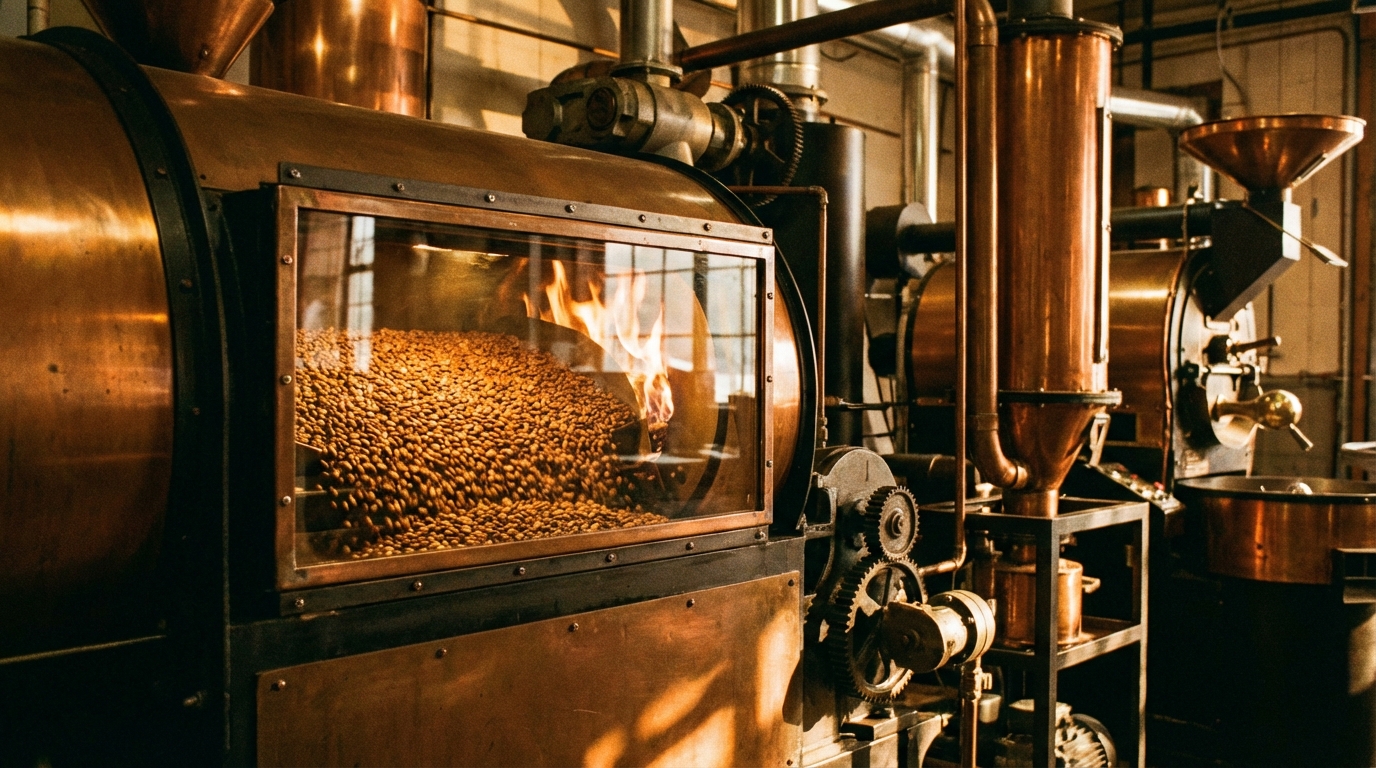
Between the farm and your cup, there is a stage that radically transforms coffee: roasting. The green bean — raw, with no coffee aroma and a vegetal taste — enters the roaster and emerges as something completely different: brown, aromatic, full of complexity. But this transformation does not happen by chance. Every decision the roast master makes directly impacts what you will experience with that first sip.
Receiving Green Beans: Where It All Begins
Everything starts when bags of green coffee arrive at the roastery. But you cannot simply open a bag and toss it into the roaster. The reception process is meticulous.
Visual analysis
The first step is visual. The roast master spreads a sample of beans across a table and examines them carefully. What they are looking for:
- Uniform color: healthy green beans have a consistent blue-green or yellow-green color. Beans with dark spots, whitish patches, or discoloration may indicate fermentation problems, uneven drying, or contamination
- Size: uniformly sized beans roast more evenly. Very small beans mixed with large ones result in uneven roasting — the small ones burn while the large ones remain underdeveloped
- Shape: deformed, hollow, or shell-shaped beans (with loose silver skin) may indicate problems in fruit development
Sorting: separating the wheat from the chaff
Sorting is the manual removal of defective beans. Even in high-quality lots, some problematic beans may be present:
- Black beans: fully oxidized, with a fermented and unpleasant flavor
- Sour beans: partially fermented, contributing acrid and astringent notes
- Stones and twigs: can damage the roaster, and stones can even chip teeth
- Insect-damaged beans: bored by the coffee berry borer, with visible tunnels inside
- Immature green beans: harvested too early, resulting in vegetal and astringent flavors
This step may seem simple, but it is fundamental. A single black bean in a cup of coffee can ruin the entire sensory experience. In specialty coffee roasting, sorting is done with extreme rigor, often bean by bean.
Moisture analysis
The moisture content of the green bean is measured with specialized equipment. The ideal range is between 10% and 12%. Beans that are too moist can develop mold during storage. Beans that are too dry have lost aromatic compounds and result in lifeless roasts. Moisture also directly affects how the bean behaves inside the roaster, influencing the speed of heat transfer.
Roast Profile: The Science Behind Flavor
The roast profile is essentially the recipe that the roast master follows. It defines how temperature evolves over time during the roasting process, and this is where science meets art.
Temperature and time
A coffee roaster is, in simple terms, a heated rotating drum. Green beans are typically charged at temperatures between 180 and 220 degrees Celsius. From there, a sequence of chemical transformations occurs:
- Drying phase (0-5 minutes): residual moisture in the bean evaporates. The bean changes from green to straw yellow. The aroma resembles cut grass or toasting bread
- Maillard reaction (5-8 minutes): amino acids and sugars react with each other, creating hundreds of aromatic compounds. It is the same reaction that browns bread and meat. The bean darkens to light brown
- First crack (8-11 minutes): internal pressure causes the bean to expand and “crack,” similar to popcorn. This sound is a critical marker. From this point, the bean can be considered roasted
- Development (11-15+ minutes): the time after first crack determines how developed the roast will be. A few seconds make a significant difference
The roast curve
The roast master monitors bean temperature in real time, plotting a curve on a graph. This curve reveals:
- Rate of Rise (RoR): the speed at which temperature is climbing. An RoR that drops too quickly can result in a “baked” and dull roast. An RoR that does not drop enough can lead to scorching
- Development time: the percentage of total roast time that occurs after first crack. Typically between 15% and 25% of total time
- End temperature: the temperature at which the roast is stopped, determining the degree of darkness
Each lot of green coffee has an ideal roast profile, discovered through testing and adjustment. What works for a natural Bourbon from Brazil’s Cerrado region may be completely unsuitable for a washed Gesha from Colombia.
Light, Medium, and Dark Roast: What Changes in Flavor
The classification into light, medium, and dark is a useful simplification, but it conceals a continuous spectrum of possibilities.
Light roast
The roast is stopped shortly after first crack. The bean retains more of its original organic acids, resulting in:
- Vibrant and pronounced acidity
- Floral, fruity, and citrus notes
- Lighter body
- Flavor that reflects the terroir and variety more than the roasting process
- Slightly more preserved caffeine
Light roast is preferred for high-scoring specialty coffees because it allows the unique characteristics of the bean to express themselves fully. However, it demands beans of exceptional quality — there is nowhere to hide defects.
Medium roast
The middle ground between preserving bean characteristics and adding complexity from the roast. Results in:
- Balance between acidity and body
- Notes of caramel, milk chocolate, nuts
- More evident sweetness
- Versatility: works well across various brewing methods
It is the roast many consider the most accessible, pleasing both beginners and experienced tasters.
Dark roast
The roast continues significantly past first crack, sometimes reaching second crack (when oils migrate to the bean’s surface). Characteristics:
- Reduced or absent acidity
- Heavy, full body
- Notes of dark chocolate, burnt caramel, spices
- Flavor dominated by the roasting process, not the terroir
- Oily bean surface
Dark roast has its place, especially in traditional Italian espresso and in milk-based drinks where intense flavor stands up to dilution. But in the specialty coffee world, roasting too dark is seen as wasteful: you pay for an exceptional bean and then erase its unique characteristics with excessive heat.
Post-Roast Quality Control: Internal Cupping
Roasting does not end when the bean leaves the roaster. Quality control work is equally important.
What cupping is
Cupping is the standardized method of sensory coffee evaluation developed by the Specialty Coffee Association (SCA). At the roastery, internal cupping happens with every roasted lot, following a rigorous protocol:
- Grinding: roasted beans are ground to a specific particle size (medium-coarse)
- Dry aroma evaluation: the evaluator smells the ground coffee before adding water, seeking initial aromatic notes
- Infusion: water at 93 degrees Celsius is poured directly over the grounds in the cup, with no filter
- Breaking the crust: after four minutes, the evaluator “breaks” the crust of grounds that formed on the surface, releasing concentrated aromas
- Tasting: using a special spoon, the evaluator noisily slurps the coffee, spreading it across the entire mouth to assess acidity, sweetness, body, flavor, aftertaste, and balance
What is evaluated
Each attribute receives a score, and together they form the sensory profile of the lot:
- Fragrance/Aroma: the smells of dry coffee and brewed coffee
- Flavor: the overall impression on the palate
- Aftertaste: what remains after swallowing
- Acidity: the perceived liveliness and brightness
- Body: the sensation of weight and texture in the mouth
- Uniformity: consistency between cups from the same lot
- Sweetness: presence of perceivable sugars
- Clean cup: absence of foreign or defective flavors
If cupping reveals problems, the roast master adjusts the profile and roasts a new sample. This cycle of roast-evaluate-adjust may repeat several times until the result meets the desired standard.
Consistency across lots
One of the greatest challenges in roasting is maintaining consistency. The same green coffee can vary slightly between bags, and environmental conditions like humidity and air temperature affect roaster behavior. Regular cupping ensures every lot delivered to the customer maintains the promised quality standard.
The Human Factor
Despite all available technology — temperature sensors, monitoring software, digital curves — specialty coffee roasting still fundamentally depends on human sensitivity. The roast master uses their ears to identify the crack, their nose to detect aromas indicating the roast stage, and accumulated experience to make split-second decisions.
It is this combination of science and intuition, of data and sensitivity, that transforms an anonymous green bean into something capable of moving people.
Visit Consciencia Cafe and talk with our team about the roast behind the coffee in your cup. Whether you are exploring Iguazu Falls or discovering the Triple Border, every bean we serve has gone through this careful process, and knowing the journey makes every sip even more meaningful.